
Corrosion-Resistant Materials for Coastal Construction: Galvanic Isolation, Flashings and Cut Edges
Technical specification guide to corrosion resistant materials coastal construction projects need, covering coastal building corrosion protection, galvanic corrosion copper aluminum rules, and coastal metal flashing selection.
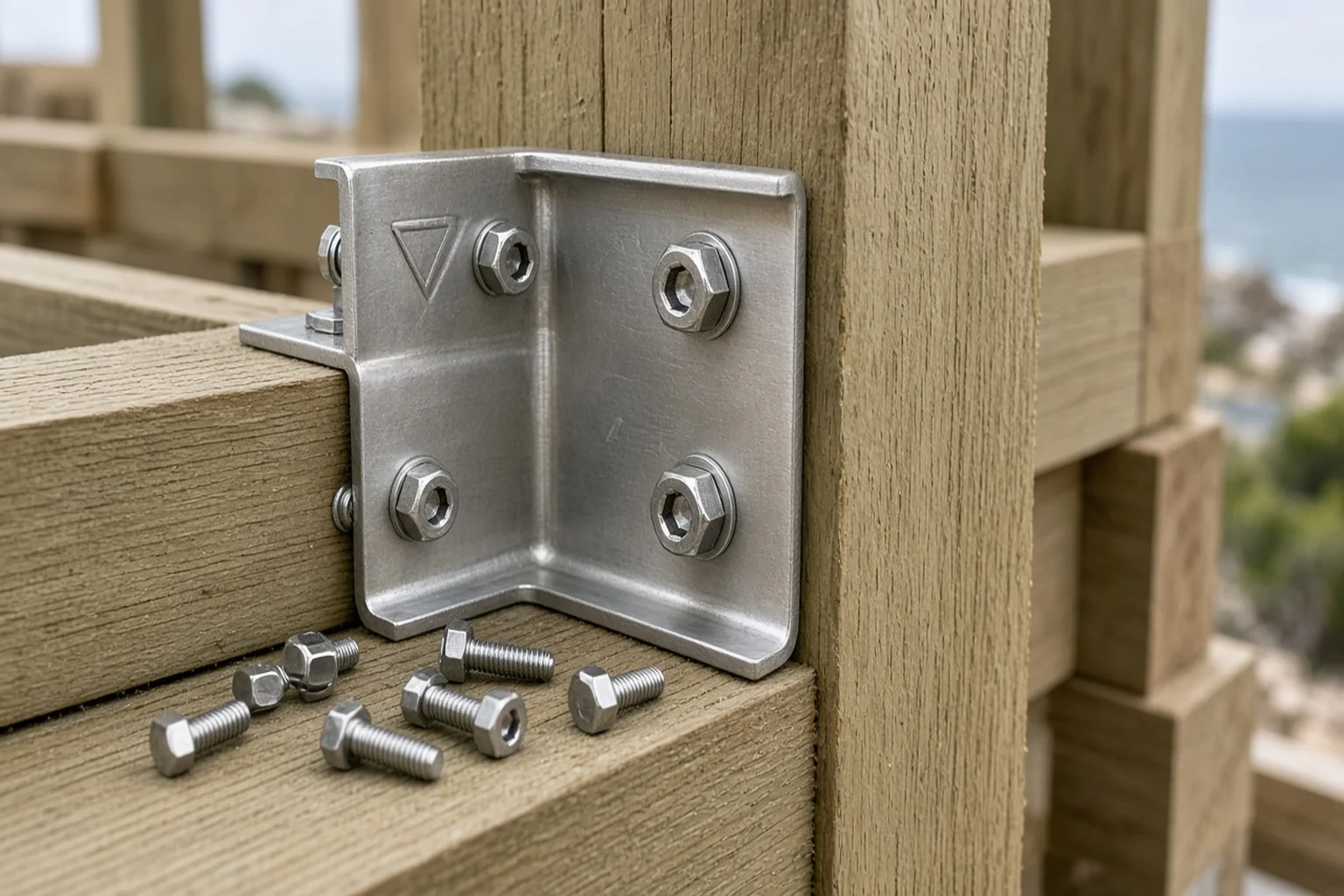
Selecting corrosion resistant materials coastal construction envelopes depend on requires matching every metal flashing, structural connector, and fastener to the local salt-air exposure, the adjacent wood treatment chemistry, and the electrochemical activity of neighboring metals. Within the broader Climate & Durability framework and our foundational Coastal Construction Guide, durable coastal building corrosion protection begins by defining where marine chloride deposition is active, how dissimilar metals interact in salt-laden moisture, and which fabrication practices preserve factory protective coatings in the field.
The amount of salt spray in the air is greatest near breaking waves and declines rapidly in the first 300 to 3,000 feet landward of the shoreline.
Despite the inland reduction in salt spray, studies have shown accelerated corrosion rates as far inland as 5 to 10 miles (IMOA, 2009).
In partially sheltered areas (such as under-house storage, parking areas below piling-, column-, or post-supported buildings, and areas under roof overhangs, decks, screened-in porches, and walkways), corrosion can significantly weaken nominally galvanized light gauge metal connectors in 5 to 10 years or sooner.
Galvanic corrosion between dissimilar metals typically requires three criteria to occur: (1) two or more dissimilar metals, (2) metal to metal contact, and (3) both metals to reside in the same conducting solution/corrosive environment, i.e. salt air or water.
To eliminate the potential for galvanic corrosion, stainless steel connectors must be attached with stainless steel nails when separate fasteners are needed; in coastal applications, stainless steel should be Type 304 or Type 316, and Type 316 is more resistant to corrosion and should be used for stainless steel metal connectors.
How Far Inland Does Coastal Salt Air Accelerate Metal Corrosion?
Evaluating corrosion resistant materials coastal construction specifications requires looking beyond beachfront parcels to understand how distance, elevation, wind transport, and relative humidity govern chloride attack. While perimeter joint elastomers and window flashing tapes are covered separately in Coastal Construction Sealants and Waterproofing, metal selection depends on how airborne salt accumulates on exposed and sheltered building components.
Tests in North Carolina in the 1940s found that samples of iron corroded 10 times faster 80 feet landward of the shoreline than samples of the same material 800 feet landward of the shoreline (LaQue, 1975).
In tests at Kure Beach, NC, the rate of corrosion reached a peak at approximately 12 feet above the ground near the shoreline, approximately equal to the lowest floor elevation of an elevated building with parking underneath.
FEMA’s Mitigation Assessment Team in Puerto Rico following Hurricanes Irma and Maria identified areas farther inland than 3,000 feet landward of the ocean where significant corrosion was noted on exposed structural connections, suggesting that in some areas, building owners may want to consider using hot-dip galvanized or stainless steel connectors farther inland than the 3,000 feet landward of the ocean guideline.
The Qualicoat Standard for coated architectural aluminum in the United Kingdom and Ireland defines coastal as within 5 km (2.8 mi) from any coast or tidal estuary.
Various sources use 457.2 m (1500 ft), 2.4 km (1.5 mi), or within eyesight of the ocean as coastal definitions, while AAMA’s Coastal Corrosion Task Group uses 2010 National Atmospheric Deposition Program (NADP) maps showing a threshold level of 4.5 kg of chlorine ion wet deposition per 1 ha (9.92 lb per 2.47 acres).
Salt accumulations have been documented up to 1.9 km (1.2 mi) downwind from busy roadways and as high as the 59th floor of high-rises.
Sodium chloride becomes continuously corrosive above 10 C (50 F) and 76 percent relative humidity (RH), whereas calcium and magnesium chlorides are corrosive at 0 C (32 F) and 45 or 50 percent relative humidity, respectively.
Because sheltered or covered areas do not benefit from occasional rinsing from rain, they accumulate more salt and undergo higher corrosion rates.
On Type 316 stainless steel railings exposed to de-icing salt and separated from roadways by a sidewalk, a rough abrasive-blasted surface retains far more salt and exhibits superficial corrosion compared to a smooth surface, and if a rough finish is desired or salt exposure is higher, a more corrosion-resistant stainless steel such as 2205 is required.
| Exposure Parameter | Documented Coastal Benchmark |
|---|---|
| Primary shoreline salt-spray drop-off | The amount of salt spray in the air is greatest near breaking waves and declines rapidly in the first 300 to 3,000 feet landward of the shoreline. |
| Inland reach of accelerated corrosion | Despite the inland reduction in salt spray, studies have shown accelerated corrosion rates as far inland as 5 to 10 miles (IMOA, 2009). |
| Vertical corrosion peak near surf | In tests at Kure Beach, NC, the rate of corrosion reached a peak at approximately 12 feet above the ground near the shoreline, approximately equal to the lowest floor elevation of an elevated building with parking underneath. |
| Partially sheltered light-gauge hardware | In partially sheltered areas (such as under-house storage, parking areas below piling-, column-, or post-supported buildings, and areas under roof overhangs, decks, screened-in porches, and walkways), corrosion can significantly weaken nominally galvanized light gauge metal connectors in 5 to 10 years or sooner. |
| Hygroscopic salt activation thresholds | Sodium chloride becomes continuously corrosive above 10 C (50 F) and 76 percent relative humidity (RH), whereas calcium and magnesium chlorides are corrosive at 0 C (32 F) and 45 or 50 percent relative humidity, respectively. |
How Does Galvanic Corrosion Between Copper, Aluminum, Zinc and Stainless Steel Work?
Addressing galvanic corrosion copper aluminum and coated-steel interactions is essential when specifying roof flashings, gutters, facade panels, and fasteners in marine air. When two dissimilar metals share an electrical path in the presence of salt air or runoff water, the more active metal (the anode) sacrifices itself to protect the more noble metal (the cathode).
Steelscape lists metals on the galvanic scale from MORE ACTIVE METALS (ANODE) to LESS ACTIVE OR NOBLE METALS (CATHODE) in the order: Zinc, ZINCALUME Steel, Aluminum, Steel, Lead, Copper, and Stainless Steel.
Standards for evaluating galvanic series and dissimilar metals include ASTM G82-98(2014) (Standard Guide for Development and Use of a Galvanic Series for Predicting Galvanic Corrosion Performance) and MIL-STD-889C (Department of Defense Standard Practice: Dissimilar Metals, 22-AUG-2016).
To minimize galvanic corrosion on galvanized steel, avoid combining a small area of galvanized steel (such as galvanized fasteners) with a large area of cathodic metal (such as carbon steel, copper, or stainless steel); generally, an anode-to-cathode surface ratio of at least 10:1 is recommended.
Stainless-steel fasteners, rivets, light fixtures, window frames, and other accessories recessed in metallic-coated panels in corrosive environments (such as a roof 300ft from ocean) can cause galvanic corrosion where the steel underneath corrodes and causes paint bubbling.
Most stainless-steel hardware, such as clips and fasteners, are not intended to be used with ZINCALUME coated steel profiles in corrosive environments; in these environments stainless steel components should be used in conjunction with profiles fabricated out of aluminum.
While contact between a galvanized surface and aluminum or stainless steel is unlikely to cause substantial incremental corrosion in mild-to-moderately corrosive environments, under very humid conditions or corrosive environments (including atmospheres close to bodies of salt water), these materials may require electrical isolation from each other.
How Do Copper Runoff and Catchment Rules Affect Coastal Metal Flashing Selection?
Even when two metals do not touch directly, water draining across a noble metal can transport dissolved ions onto a more active metal below, making drainage order a critical part of coastal metal flashing selection.
Metallic coated steel will experience accelerated corrosion when in contact with copper or copper treated lumber, and leaching of copper through water run-off from rainfall or condensation breaks down the protective oxide film on aluminum-zinc coatings in localized areas and causes pitting corrosion without direct metal to metal contact.
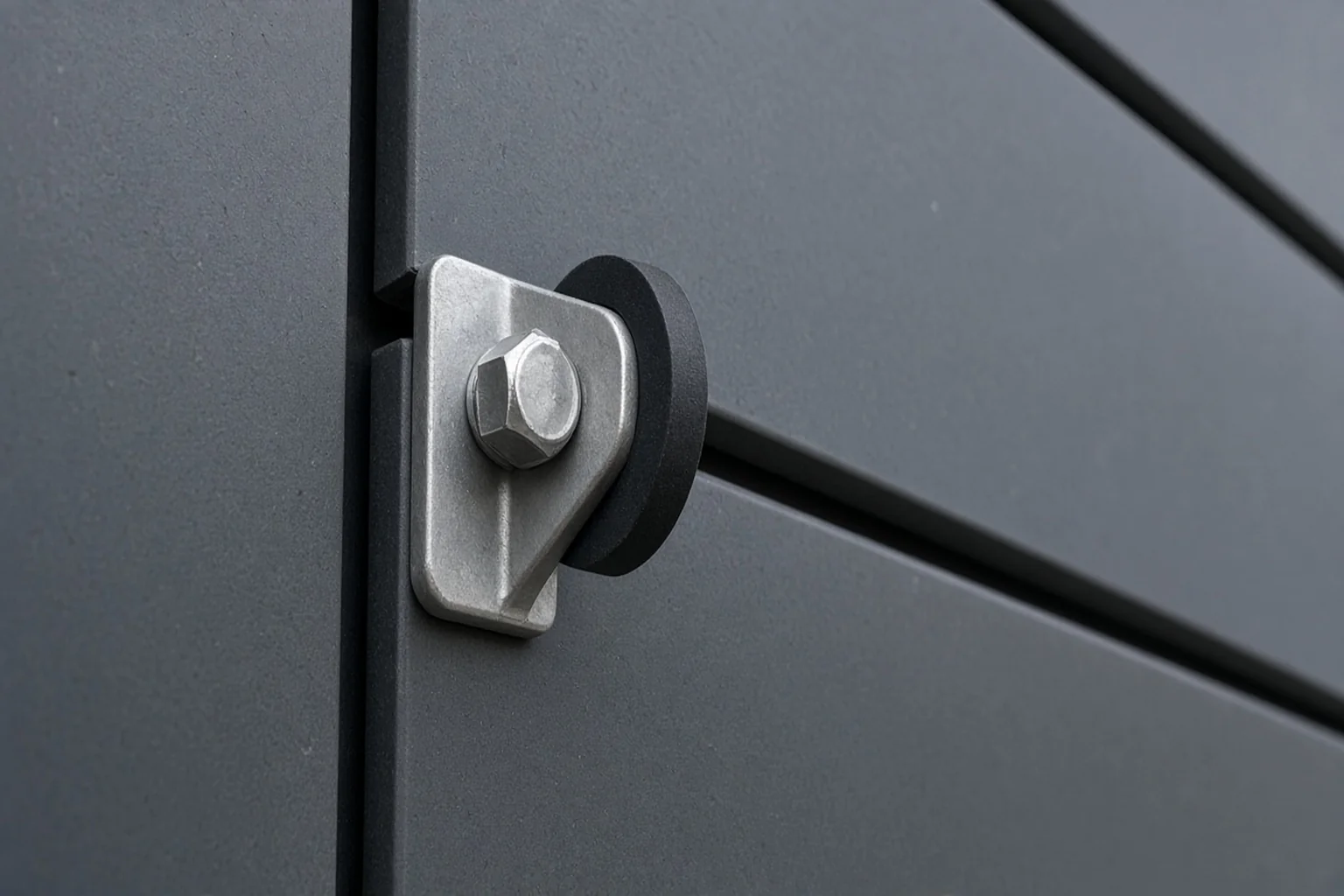
Even runoff water from copper or brass surfaces can contain enough dissolved copper to cause rapid corrosion of zinc; if contact is unavoidable, joint faces should be insulated with non-conducting gaskets, connections made with insulating grommet-type fasteners, and the design should ensure water flows from the galvanized surface towards the copper or brass surface and not the reverse.
Unpainted galvanized steel must not be used for roofing or rainwater goods (including valleys and gutters) to collect water runoff from ZINCALUME Steel or other more noble metals; ZINCALUME Steel and painted ZINCALUME Steel can collect water from galvanized catchment material, but neither product should be used as catchment material for roofs featuring more noble metals such as aluminum or copper.
Which Spacer Materials Provide Electrical Isolation in Facade and Flashing Joints?
When structural framing and exterior cladding require different alloys, breaking the electrical circuit prevents anodic sacrifice at the connection interface.
For electrical isolation (removal of return current path) between dissimilar metals, common electrically inert spacer materials with a very low ability to absorb moisture include neoprene, rubber, plastic, Mylar, nylon, Teflon, glass reinforced epoxy (GRE) gaskets, corrosion-inhibiting pastes, dried adhesives, and sealants.
In curtain wall and facade framing, steel has a Young’s modulus of approximately 207 million kPa (29 million psi) compared to aluminum’s 69 million kPa (10 million psi), and when dissimilar facade metals cannot be aligned on the galvanic series, galvanic corrosion can be mitigated by inserting non-conductive spacers with low moisture absorption such as neoprene, nylon, plastic, or rubber, or by applying corrosion-inhibiting pastes, sealants, and dried adhesives.
| Metal Pairing or Runoff Scenario | Coastal Compatibility and Isolation Rule |
|---|---|
| Anode-to-cathode order | Steelscape lists metals on the galvanic scale from MORE ACTIVE METALS (ANODE) to LESS ACTIVE OR NOBLE METALS (CATHODE) in the order: Zinc, ZINCALUME Steel, Aluminum, Steel, Lead, Copper, and Stainless Steel. |
| Galvanized anode to cathodic sheet area | To minimize galvanic corrosion on galvanized steel, avoid combining a small area of galvanized steel (such as galvanized fasteners) with a large area of cathodic metal (such as carbon steel, copper, or stainless steel); generally, an anode-to-cathode surface ratio of at least 10:1 is recommended. |
| Stainless clips with ZINCALUME vs. aluminum | Most stainless-steel hardware, such as clips and fasteners, are not intended to be used with ZINCALUME coated steel profiles in corrosive environments; in these environments stainless steel components should be used in conjunction with profiles fabricated out of aluminum. |
| Roof and gutter runoff catchment order | Unpainted galvanized steel must not be used for roofing or rainwater goods (including valleys and gutters) to collect water runoff from ZINCALUME Steel or other more noble metals; ZINCALUME Steel and painted ZINCALUME Steel can collect water from galvanized catchment material, but neither product should be used as catchment material for roofs featuring more noble metals such as aluminum or copper. |
| Copper or brass runoff onto zinc coatings | Even runoff water from copper or brass surfaces can contain enough dissolved copper to cause rapid corrosion of zinc; if contact is unavoidable, joint faces should be insulated with non-conducting gaskets, connections made with insulating grommet-type fasteners, and the design should ensure water flows from the galvanized surface towards the copper or brass surface and not the reverse. |
How Should You Select Galvanized and Stainless Steel Connectors and Fasteners?
Specifying coastal building corrosion protection for structural timber connectors, truss plates, and fasteners requires verifying both the zinc coating mass and the alloy compatibility between connectors and nails.
Galvanized steel can degrade up to more than 50 times slower than ungalvanized steel in the same coastal environment.
Under ASTM A653 (2015a), hardware designated as G185 has a galvanized coating that weighs 1.85 oz/ft2 (including both surfaces of the coated material) and a minimum of 0.64 oz/ft2 on one side.
Compared to standard G60 or G90 grades, G185 to G200 grades of galvanized protection have zinc coatings that are two to three times thicker and should last approximately two to three times longer than G60 or G90 connectors.
The IBC and IRC prohibit mechanical galvanizing for driven fasteners such as nails and timber rivets because mechanically galvanized coatings may deteriorate during installation.
National standards for galvanizing referenced by the I Codes and ASCE 24 include ASTM A653 for hot-dip galvanized steel sheets, ASTM A153/A153M for metal connectors hot-dip galvanized after fabrication, ASTM A123 for hot-dip galvanizing of most fasteners, and ASTM B695-04 (Class 55 minimum thickness) for mechanically deposited zinc in contact with preservative-treated lumber.
In the absence of direction, the I-Codes require that a minimum G185 zinc-coated steel be used when connectors are in contact with preservative-treated lumber, and Type 304 or Type 316 stainless steel is regarded as exceeding the minimum G185 zinc-coated steel code requirement for corrosion protection.
Carbon-steel fasteners and anchors with coatings such as hot-dip galvanization will corrode faster than the stainless steel connectors, and fasteners or anchors made from lower grades of stainless steel, such as types 304/305 (aka “18-8 stainless”), are also not recommended for use with Simpson Strong-Tie type 316 stainless steel connectors.
Simpson Strong-Tie does not recommend painting stainless-steel anchors, fasteners, or connectors because imperfections or damage to the paint can facilitate collection of dirt and water that can degrade or block the passive formation of the protective chromium oxide film, initiating crevice corrosion visible as a brown stain or red rust.
Under ANSI/TPI 1-2014 design specifications, the three industrial coating options for increasing corrosion resistance on metal truss plates are epoxy-polyamide primer (SSPC-Paint 22), coal tar epoxy-polyamide black or dark red paint (SSPC-Paint 16), and post-plate manufacture hot-dip galvanizing (zinc-based) per ASTM A153/A153M (ASTM, 2016).
How Do Copper-Treated Lumber and Barrier Membranes Affect Coastal Metal Flashing Selection?
Detailed inspection sequences for ledger drainage planes appear in our Deck Ledger Flashing Review; the rules below govern material compatibility, chemical retention thresholds, and barrier membrane pairings.
Testing by Simpson Strong-Tie has shown that ACQ-Type D is more corrosive to steel connectors and fasteners than Copper Azole, Micronized Copper Azole, or CCA-C, while other tests have shown that inorganic boron treatment chemicals, specifically SBX-DOT, are less corrosive than CCA-C.
Type 316/305/304 stainless-steel products are recommended where preservative-treated wood used in ground contact has a chemical retention level greater than those for AWPA UC4A: CA-C, 0.15 pcf; CA-B, 0.21 pcf; micronized CA-C, 0.14 pcf; micronized CA-B, 0.15 pcf; and ACQ-Type D (or C), 0.40 pcf; mechanical galvanizations C 3 and N2000 should not be used in conditions that would be more corrosive than AWPA UC3A.
To resist corrosion under [R317.3], hot-dipped galvanized fasteners for preservative-treated wood shall meet ASTM A 153, Class D for fasteners 3/8” diameter and smaller or Class C for larger diameters, mechanically deposited zinc-coated fasteners shall meet ASTM B 695, Class 55, minimum, connectors shall meet ASTM A 653, G-185 coating or ASTM A 123, and fasteners and connectors exposed to salt water or within 300 feet of a salt water shoreline shall be stainless steel grade 304 or 316 of the same corrosion-resistant material.
- Flashing shall be corrosion-resistant metal [R703.8] of minimum nominal 0.019-inch thickness or approved non-metallic material, and aluminum should not be used in direct contact with lumber treated with preservatives that contain copper such as ACQ, Copper Azole, or ACZA.
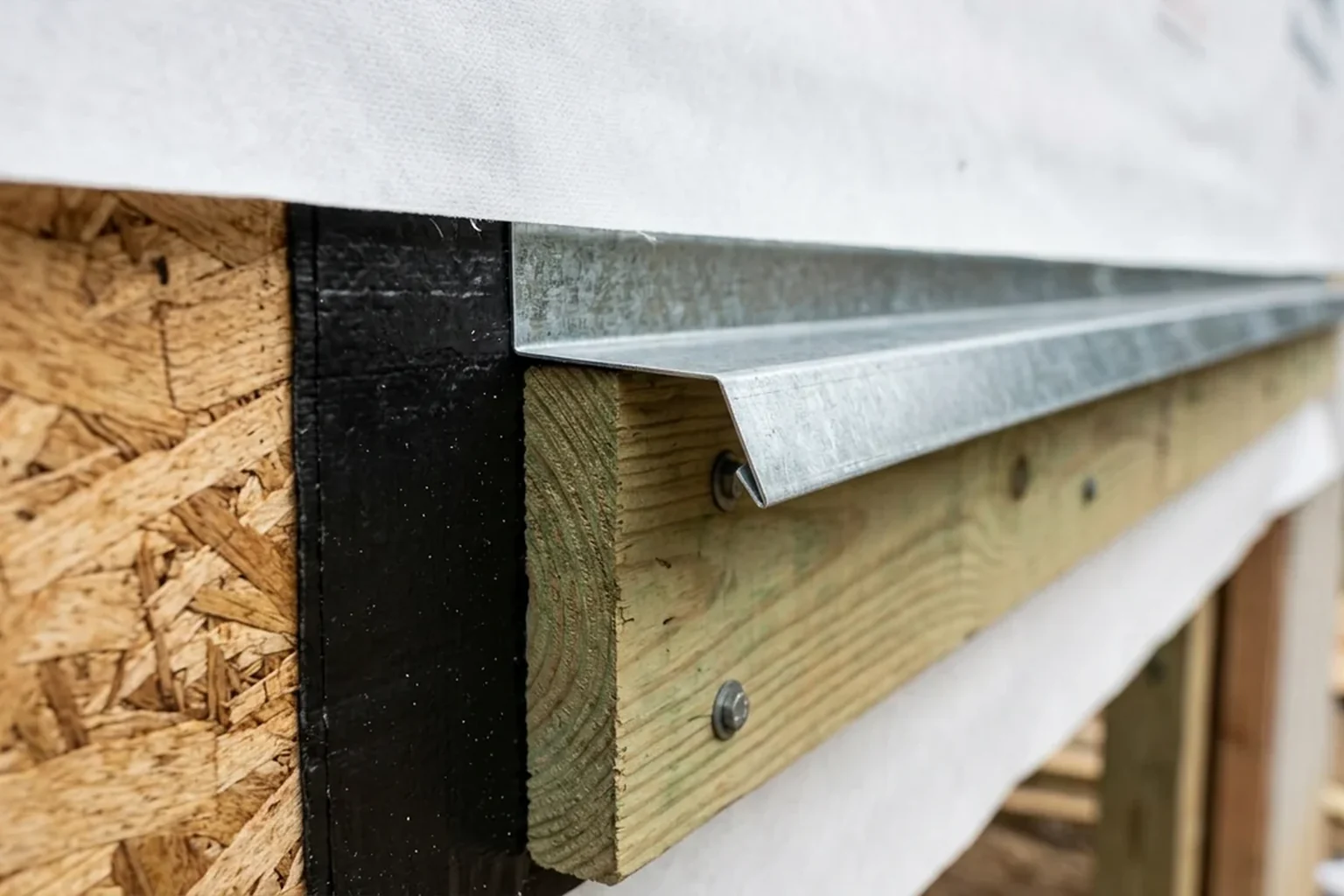
At a deck ledger board with a separate WRB Behind Deck Ledger, the drainage plane above ledger is detailed to lap over flashing which is placed over waterproof membrane, and the drainage plane is tucked under waterproof membrane below ledger.
Because the typical house band joist (or engineered rim board) is not made from PPT lumber, water intrusion at a deck attachment can lead to wood decay around bolts or lag screws and connection failure; a PPT house band—with compatible corrosion-resistant fasteners—at the deck attachment location is recommended, and Section R507.2.3 requires at least two lateral bracing connectors with a design load capacity of 6.67 kN (1500 lb).
Barrier membranes act as a barrier between preservative-treated wood and metal connectors, eliminating direct contact and reducing the electrochemical reaction (which requires moisture) from occurring between the two surfaces, but the barrier membrane does not provide protection for fasteners installed through the membrane into the wood.
Stainless steel connectors and fasteners should not be used with Grace Vycor Deck Protector, and Hot-Dip Galvanized fasteners (per ASTM A153 standards) must always be used in conjunction with Grace Vycor Deck Protector whether using G90 galvanized connectors, ZMAX (G185) connectors, or Hot-Dip Galvanized connectors.
Barrier membrane corrosion testing was conducted by Grace Construction Products in conformance with ASTM G59 and in general conformance with the American Wood Preservers’ Association Standard E-12-94 using steel coupons with a Hot-Dip Galvanized coating conforming to ASTM A653 class G90 (0.90 oz/ft^2 of zinc total both sides).
| Treated-Wood Ledger or Barrier Condition | Required Flashing, Connector, and Fastener Specification |
|---|---|
| Ledger flashing thickness and copper-treated wood | 11. Flashing shall be corrosion-resistant metal [R703.8] of minimum nominal 0.019-inch thickness or approved non-metallic material, and aluminum should not be used in direct contact with lumber treated with preservatives that contain copper such as ACQ, Copper Azole, or ACZA. |
| Preservative-treated wood and shoreline zone | To resist corrosion under [R317.3], hot-dipped galvanized fasteners for preservative-treated wood shall meet ASTM A 153, Class D for fasteners 3/8" diameter and smaller or Class C for larger diameters, mechanically deposited zinc-coated fasteners shall meet ASTM B 695, Class 55, minimum, connectors shall meet ASTM A 653, G-185 coating or ASTM A 123, and fasteners and connectors exposed to salt water or within 300 feet of a salt water shoreline shall be stainless steel grade 304 or 316 of the same corrosion-resistant material. |
| High-retention treated wood chemical threshold | Type 316/305/304 stainless-steel products are recommended where preservative-treated wood used in ground contact has a chemical retention level greater than those for AWPA UC4A: CA-C, 0.15 pcf; CA-B, 0.21 pcf; micronized CA-C, 0.14 pcf; micronized CA-B, 0.15 pcf; and ACQ-Type D (or C), 0.40 pcf; mechanical galvanizations C 3 and N2000 should not be used in conditions that would be more corrosive than AWPA UC3A. |
| Grace Vycor Deck Protector barrier membrane pairing | Stainless steel connectors and fasteners should not be used with Grace Vycor Deck Protector, and Hot-Dip Galvanized fasteners (per ASTM A153 standards) must always be used in conjunction with Grace Vycor Deck Protector whether using G90 galvanized connectors, ZMAX (G185) connectors, or Hot-Dip Galvanized connectors. |
How Should Prefinished Metal Panels and Flashings Be Cut and Detailed at Edges?
Even when corrosion resistant materials coastal construction schedules specify premium metallic-coated steel or powder-coated aluminum, improper field cutting or sharp unrounded edges can trigger premature cut-edge rust and paint delamination.
Sawing or abrasive cutting actions can exceed the melting temperature of the metallic coating and melt it away from the base steel, and produce “swarf,” the name for the fine residual metallic filings and pieces that can corrode and cause rust stains if left on a metal surface.
A panel cut with an abrasive blade requires a scissors-type hand tool to trim back the cut edge 12.7 mm (0.5 in.) if the panel end is to be left exposed to weather, whereas power shears are electrical scissors that cut a straight strip of material out of the panel approximately 3.17-mm (0.125-in.) wide.
Carbide-tipped 6.35-mm (0.25-in.) circular blades are available with 48 or 70 teeth per blade where the 48-tooth blade will cut up to 3.17-mm (0.125-in.) thick steel; saw spin rate should be no more than 2,500 rpm; when a spark stream is produced while cutting, the edges of the cut are being heated beyond 199 C (390 F), destroying both the Zincalume/Galvalume corrosion coating and the pigmented color finish.
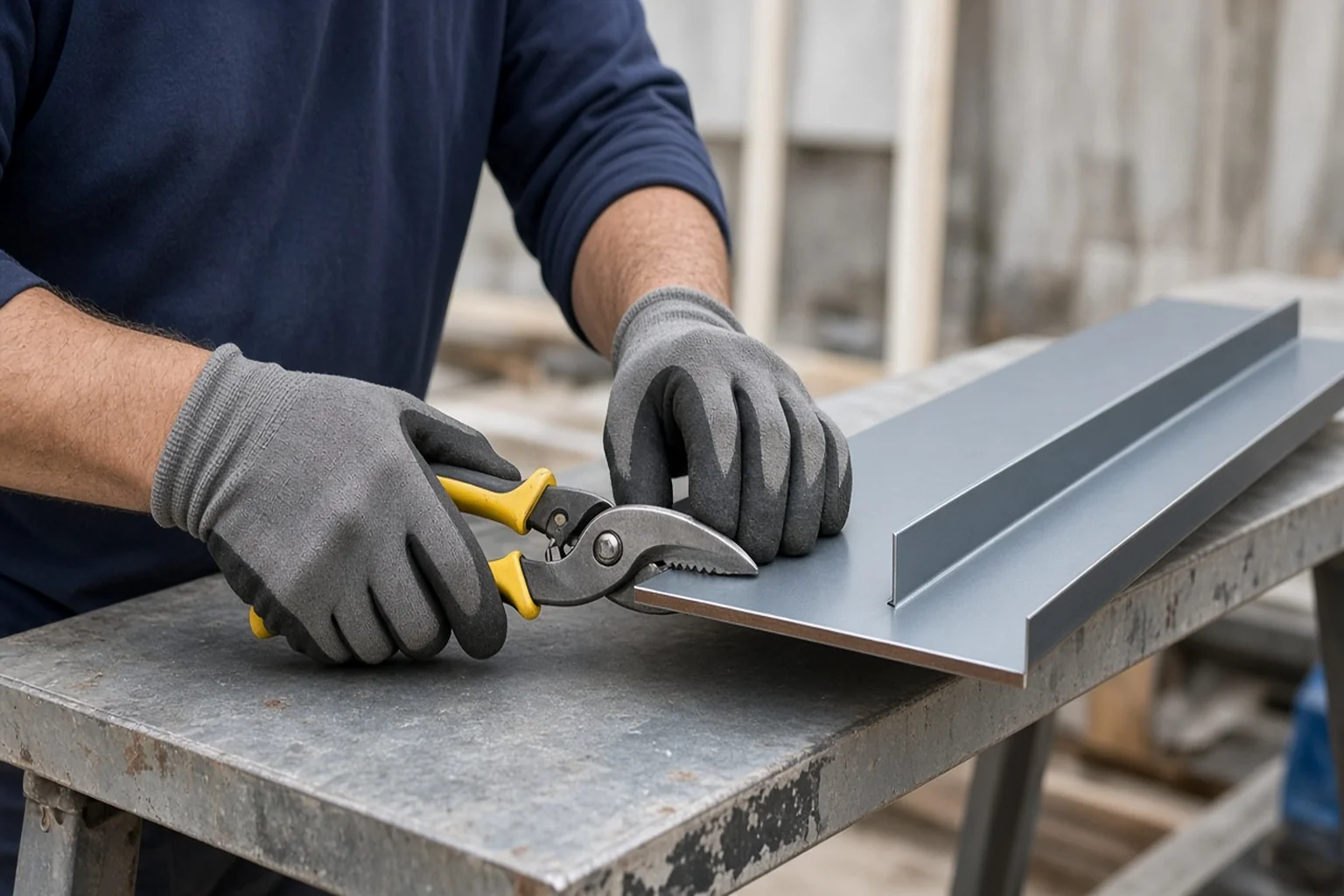
Preferred tools for field cutting prefinished metal panels include aviation snips, sheet metal shears, guillotine-style shearing blades, nibblers, and power shears; unlike galvanized coatings, which are purely sacrificial, zinc and aluminum are included in ZINCALUME so that while zinc will corrode preferentially, aluminum acts as a protective barrier, slowing the spread of corrosion.
By shearing the material as is done in the factory, the zinc and aluminum coating is essentially folded over the exposed raw edge of the base steel so galvanic action causes zinc compounds to automatically build up at any cut edges or scratches, and panel edges can be “hemmed,” whereby the exposed edge is folded and tucked underneath so the edge is not as exposed to environmental elements.
In powder coating applications on metal edges, electrostatic and surface tension effects can leave sharp edges with only 30 to 70 percentage of the nominal thickness present elsewhere on the part; edges should be rounded to a radius of 2 millimeters wherever possible, and when design, formulation, process control, and a zinc rich epoxy primer with a polyester or polyurethane topcoat are combined, contemporary powder coating systems can achieve long term corrosion resistance of 10 to 25 years in C4 and C5 environments.
Sources
- Federal Emergency Management Agency — Corrosion Protection for Metal Connectors and Fasteners in Coastal Areas
- The Construction Specifier — Avoiding De-Icing Salt Corrosion
- The Construction Specifier — Selecting Aluminum Finishes for Coastal Areas
- Steelscape Technical Bulletin — Dissimilar Metals and Galvanic Corrosion
- American Galvanizers Association — Dissimilar Metal Corrosion with Zinc
- American Galvanizers Association — Hot-Dip Galvanized Steel in Contact with Other Metals
- Simpson Strong-Tie — Stainless Steel Fasteners and Wood Connector Corrosion Guidance
- Simpson Strong-Tie — Pressure-Treated Wood with Barrier Membranes
- American Wood Council — Prescriptive Residential Wood Deck Construction Guide
- Metal Construction News — Out in the Field: Cutting Prefinished Metal Panels
- Building Science Corporation — Integrating Deck Ledger Board with Drainage Plane
- AEP Span — Field Cutting Metal Panels
- The Construction Specifier — Structural Safety of Wood Decks and Deck Guards
- Products Finishing — Advancing Powder Coating Technologies for Enhanced Corrosion and Edge Protection
- Metal Architecture — Framing and Facades
Related articles

Coastal Construction: Corrosion, Wind, Rain, and Maintenance
Map salt, rain, wind and flood exposure before selecting materials; verify connections and maintenance access before concealing work.
Read articleCoastal Construction Products: ASTM C920 Sealants, AAMA 711 Flashing, and Type 316 Fasteners
Selecting coastal construction products requires ASTM C920 Class 50 STPE or silicone sealants, AAMA 711 Level 3 flashings, and Type 316 stainless fasteners to prevent leaks and corrosion rework.
Read article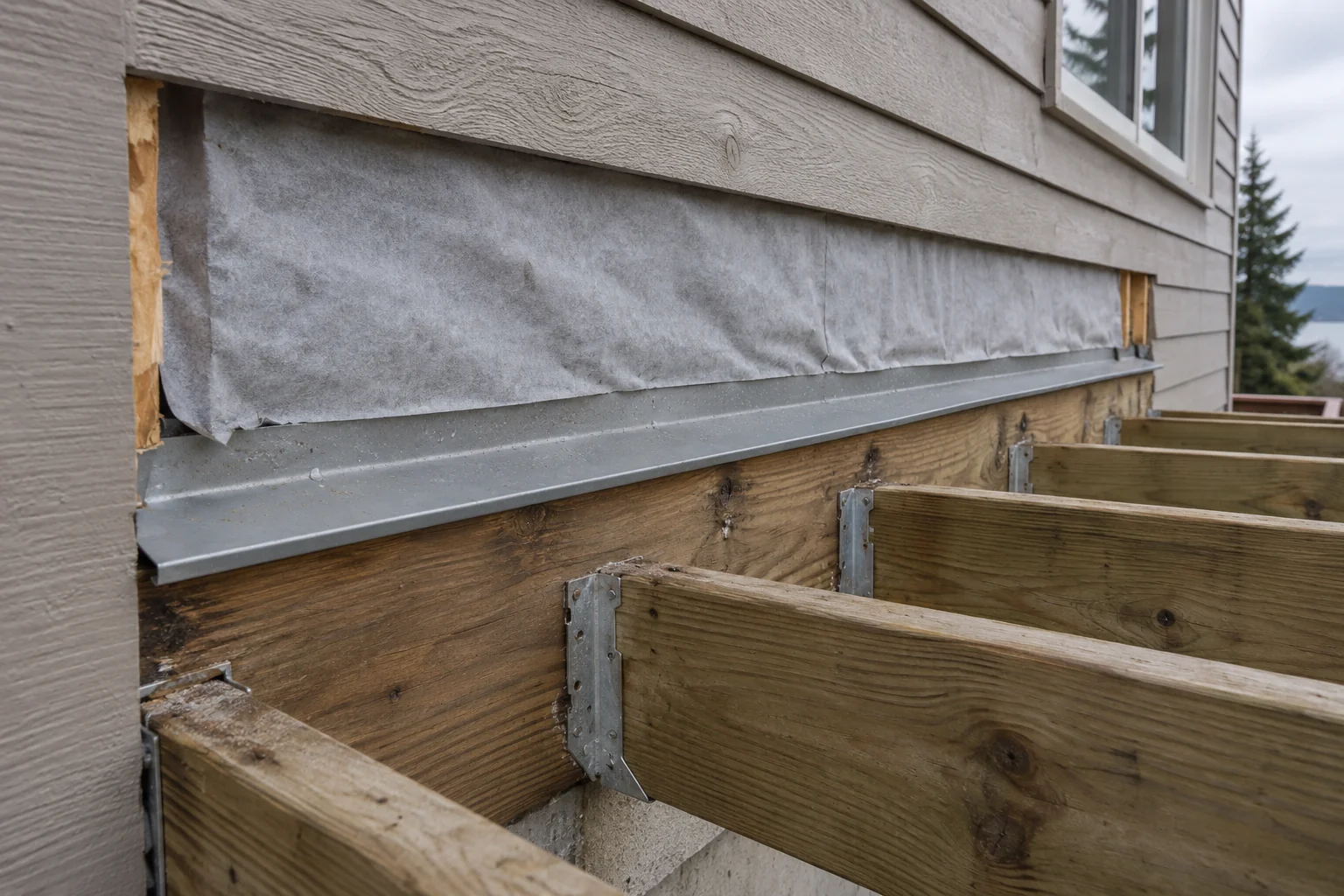
Deck Ledger Flashing Detail: A Rain and Coastal Review Record
Review the ledger water path, treated-wood and metal compatibility, and hidden damage. Copy a record for photos, product documents and closure decisions.
Read article