
Coastal Construction Products: ASTM C920 Sealants, AAMA 711 Flashing, and Type 316 Fasteners
Selecting coastal construction products requires ASTM C920 Class 50 STPE or silicone sealants, AAMA 711 Level 3 flashings, and Type 316 stainless fasteners to prevent leaks and corrosion rework.
Specifying durable coastal construction products for windward marine envelopes requires pairing ASTM C920 Class 50 silyl-terminated polyether (STPE) or neutral-cure silicone sealants with AAMA 711 Level 3 (80°C/176°F) butyl, acrylic, or fluid-applied flashings and AISI Type 316 molybdenum-bearing stainless steel fasteners (PREN 24–26). Substituting standard polyurethane caulks, modified-bitumen tapes, or Type 304 and G90 galvanized hardware within 3,000 feet of surf causes UV hydrolysis, asphaltic plasticizer bleed, and crevice corrosion that force costly window and cladding rework within three to seven years.
This component specification sits within the Climate & Durability hub. While our parent coastal construction guide covers parcel-level FEMA V-Zone and Coastal A-Zone hazard mapping, shoreline permitting, and wash-down schedules, this reference establishes the polymer chemistry, alloy thresholds, and submittal tests required across the four control layers in our building envelope basics guide.
- Specify siloxane-crosslinked joint sealants (
ASTM C920 Class 50orClass 100/50): Select STPE hybrids or neutral-cure (alkoxy/oxime) silicones verified for primerless adhesion toAAMA 2605(70% PVDF / Kynar 500) aluminum (ASTM C794 ≥ 5 pli) and non-staining performance (ASTM C1248). - Enforce
AAMA 711 Level 3(80°C / 176°F) flashing thermal stability: Use 100% butyl, solid acrylic, or vapor-permeable fluid-applied STPE flashings (≥ 1.5 lbs/inpeel andASTM D19705-inch water-head nail sealability); prohibit rubberized asphalt behind dark siding or on PVC window fins. - Size sill pan back-dams to design wind pressure: Calculate vertical back-dam and end-dam heights from cyclic wind-driven rain pressures (
ASTM E331 / E547at6.24 to 15.0+ psf) usingh_dam = (0.192 × P_wind) + 0.50 in.freeboard. - Mandate
AISI Type 316stainless steel (PREN 24.2–26.1) within 3,000 feet of surf: FollowFEMA Technical Bulletin 8andISO 9223 Category C5-M / CXrules by matchingType 316connectors exclusively withType 316fasteners and isolating6063-T6aluminum withEPDMwashers and nylon bushings. - Verify field adhesion before cavity closure (
ASTM C1521): Require pre-construction lab peel tests (ASTM C794) and destructive pull-tab logs (1 test per 100 LFon the first1,000 LF).
Swipe or scroll horizontally to view all columns →
| Sub-System | Standard & Grade | Mandatory Coastal Threshold | Inland Substitution Failure & Fix |
|---|---|---|---|
| 1. Joint Sealants | WBDG Wall Systems & ASTM C920 |
Class 50 or 100/50 STPE or neutral silicone; 2:1 W:D (1/4–1/2 in.); C1248 non-staining |
Class 25 polyurethane chalks in UV, hydrolyzes, and bubbles >5% MC → use STPE or silicone |
| 2. PVDF Adhesion | AAMA 2605-20 & ASTM C794 |
≥ 5.0 pli peel with ≥ 75% cohesive failure on 70% PVDF (Kynar 500) aluminum | Caulk peels off low-energy (25–30 dynes/cm) PVDF → IPA wipe + amino-silane STPE or primer |
| 3. Flashing & WRB | AAMA 711-22 & ASTM D1970 |
Class A, Level 3 (176°F); ≥ 1.5 lbs/in peel; passes 5-in. head nail seal at 40°F |
Modified bitumen bleeds >150°F and cracks PVC fins → use butyl, acrylic, or fluid STPE |
| 4. Sill Pan & Dam | BSD-105 & ASTM E331 / E547 |
Sloped pan (≥ 1/4 in./ft), unsealed apron; h_dam = 0.192 × P_wind + 0.50 in. (1.75–3.50 in.) |
Flat sill or caulked bottom flange traps rain → install interior heel seal + upturned dams |
| 5. Marine Hardware | Simpson Strong-Tie, SSINA & FEMA TB-8 |
AISI Type 316 SS (2–3% Mo, PREN 24.2–26.1) < 3,000 ft; isolate 6063-T6 Al (ΔE = 0.72 V) |
Type 304 (PREN 18.8) pits; HDG G90/G185 fails in 1.7–5 yrs → 316 SS + EPDM/nylon isolation |
1. ASTM C920 Elastomeric Joint Sealants for Marine Envelopes
Exterior joints around coastal windows, curtain walls, and cladding transitions face intense solar ultraviolet (UV) irradiance, airborne chloride aerosols, and thermal swings. When a coastal construction company relies on generic inland caulks, joint failure begins within 24 to 36 months.
Why Marine UV and Salt Fog Destroy Standard Polyurethane Caulks
Under the Whole Building Design Guide (WBDG) — Exterior Wall Systems, 1K and 2K polyurethane sealants crosslink via organic urethane linkages that degrade on marine facades:
- UV Cleavage: Solar UV cleaves urethane chains, stiffening 100% modulus from
75–100 psipast150 psiand pulling window bond lines apart. - Isocyanate Outgassing (
CO2Blistering): On substrates above4%–5%moisture, free isocyanate reacts with water to evolveCO2gas blisters. - Alkaline Hydrolysis: Saltwater and alkaline masonry pore water hydrolyze urethane bonds, causing adhesive reversion.
Silyl-Terminated Polyether (STPE) vs. Neutral-Cure Silicone (ASTM C920)
Durable coastal construction products use siloxane (Si-O-Si) polymers classified under the WBDG Fenestration Systems Design Guide: ASTM C920, Type S or M, Grade NS, Class 50 (±50%) or Class 100/50 (+100%/-50%), Use NT, M, G, A, and O.
- Neutral-Cure Silicone (Alkoxy/Oxime): Inorganic
Si-O-Siquartz bonds (444 kJ/mol) resist UV for 20+ years. Ultra-low-modulus (Class 100/50,25–45 psi) grades protect fragile stucco perimeters (see our stucco drainage mat guide). Ban acetoxy silicones (acetic acid corrodes metals/masonry) and requireASTM C1248non-staining certification on porous stone. - Silyl-Terminated Polyether (STPE / MS Polymer): Methoxysilane-terminated polyethers crosslink with
0%isocyanate (no dampCO2bubbling), achievingASTM C920 Class 50(±50%), low modulus (35–65 psi),ASTM C1248non-staining compliance, and paintability.
Primerless Adhesion to AAMA 2605 (70% PVDF / Kynar 500) Aluminum
Coastal frames finished under FGIA / AAMA 2605-20 (70% PVDF, 4,000-hr salt spray) have low surface energy (25–30 dynes/cm). Require ASTM C794 peel tests proving ≥ 5.0 pli (0.88 N/mm) and ≥ 75% cohesive failure. Amino-silane STPE and alkoxy silicones pass primerless after a two-cloth isopropyl alcohol (IPA) wipe; polyurethanes require silane primer.
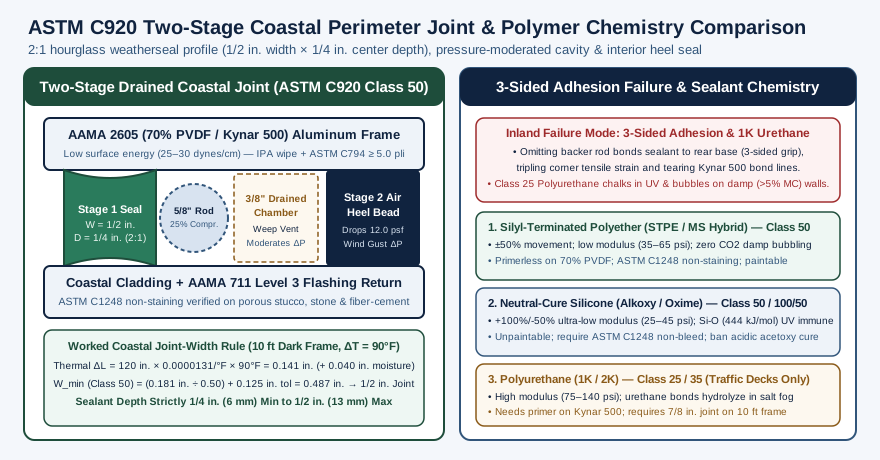
Two-Stage Joint Geometry and Worked Joint-Width Calculation
Per the WBDG Fenestration Systems Design Guide, detail a two-stage drained joint: (1) an exterior weatherseal with a 2:1 width-to-depth hourglass profile (Depth D = 0.5 × Width W, strictly 1/4 in. min to 1/2 in. max) over a closed-cell polyethylene backer rod compressed 25%–30% to prevent three-sided adhesion, and (2) a continuous interior air-barrier heel bead over AAMA 812 foam carrying the wind pressure drop (ΔP).
Threshold rule: Size nominal joint width (W_min) from thermal expansion (ΔL = L × α × ΔT) plus moisture movement (ΔM), divided by ASTM C920 movement class, plus tolerance:
Minimum Joint Width (W_min) = [(L × α × ΔT + ΔM) ÷ Movement Class] + Tolerance
Worked example (10 ft dark bronze AAMA 2605 window): A 120 in. frame (α = 13.1 × 10⁻⁶ /°F) over ΔT = 90°F expands 0.141 in. Plus 0.040 in. cladding movement (0.181 in. total), an ASTM C920 Class 50 (0.50) sealant with 0.125 in. tolerance requires W_min = (0.181 ÷ 0.50) + 0.125 = 0.487 in. → specify a 1/2 in. (13 mm) joint width × 1/4 in. (6 mm) depth over a 5/8 in. rod. (Class 25 urethane requires 0.849 in., tearing in a 1/2 in. joint.)
Swipe or scroll horizontally to view all columns →
| Parameter | STPE / MS Polymer Hybrid | Neutral-Cure Silicone | Polyurethane (1K / 2K) |
|---|---|---|---|
| ASTM C920 Class | Type S, NS, Class 50 (±50%), Use NT, M, G, A, O | Type S, NS, Class 50 or 100/50, Use NT, M, G, A, O | Type S/M, NS, Class 25 or 35, Use NT, M, A |
| 100% Modulus | Low-Medium (35–65 psi) | Ultra-Low (25–45 psi) | Medium-High (75–140 psi) |
| UV & Salt Fog | Excellent (Si-O-Si; zero CO2 bubbles) |
Superior (444 kJ/mol Si-O; 20+ yr) |
Fair-Poor (chalks, bubbles >5% MC) |
| 70% PVDF Bond | Primerless (ASTM C794 ≥ 5 pli) |
Primerless (alkoxy cure) | Requires primer on PVDF |
| Staining & Paint | Passes C1248; paintable |
Non-bleed C1248 req.; unpaintable |
Non-bleeding; traffic decks only |
Takeaway: Specify ASTM C920 Class 50 STPE hybrids when coastal joints require paintability, or Class 50 / Class 100/50 neutral-cure alkoxy silicones for unpainted AAMA 2605 frames and stucco perimeters—sized to a 2:1 hourglass profile (1/2 in. × 1/4 in.) over a backer rod.
2. Self-Adhered Flashing & Weather-Resistive Barriers (WRB) Under Wind-Driven Rain
Behind the cladding, rough-opening flashings and the Weather-Resistive Barrier (WRB) must survive high temperatures behind dark coastal siding, salt-air humidity during framing, and wind-driven rain pressurizing nail penetrations.
Decoding AAMA 711-22 Thermal Levels, Peel Adhesion, and ASTM D1970 Nail Sealability
Audit window flashing submittals against FGIA / AAMA 711-22:
- Primer Class (
Type Avs.Type B): Type A achieves ≥ 1.5 lbs/in (0.26 N/mm) 90° peel on OSB, plywood, aluminum, PVC fins, and mortar without primer. Type B requires primer to reach1.5 lbs/in. - Thermal Exposure (
Level 3Mandatory):AAMA 711-22tests thermal stability at Level 1 (50°C / 122°F), Level 2 (65°C / 149°F), and Level 3 (80°C / 176°F). Behind dark coastal metal or fiber-cement cladding (155°F–175°F),AAMA 711 Class A, Level 3 (80°C / 176°F)is mandatory. - Nail Sealability (
ASTM D1970Section 7.9): Membranes must hold a 5-inch (127 mm) water column (2.60 psf) around a galvanized nail penetration at40°F(4°C) for 72 hours without wetting underlying blotting paper.
Fluid-Applied STPE vs. 100% Butyl vs. Solid Acrylic vs. Modified Bitumen
Coordinate flashing with framing drying paths (see our moisture control in buildings guide and rainy-climate construction guide):
- Fluid-Applied STPE / Silicone Flashing & WRB: Applied at 25–40 wet mils (20–35 dry mils), STPE liquid flashings form a seamless pan, pass
ASTM E2357air-barrier testing (≤ 0.04 CFM/ft²at1.57 psf), and offer 10–25 perms (ASTM E96 Method B) for outward drying. - 100% Butyl & Solid Acrylic Tapes (
AAMA 711 Level 3): Crosslinked butyl (15–25 mils) and solid acrylic (10–15 mils,180–365 dayUV window) deliver 2.0–6.0 lbs/in peel when rolled with a ≥ 15 lb J-roller and contain zero asphaltic oils. - Why Modified Bitumen Fails: Rubberized asphalt (
Level 1or2) bleeds black oil above150°F, leaches plasticizers from PVC window fins, and softens STPE or urethane sealants on contact.
Swipe or scroll horizontally to view all columns →
| Chemistry | AAMA 711-22 Standard | Peel & D1970 Nail Seal |
Thickness & Permeance | Coastal Compatibility |
|---|---|---|---|---|
| Fluid STPE | Level 3 (176°F) + E2357 |
3.0–8.0+ lbs/in; 5-in. head | 20–35 dry mils; 10–25 perms | Seamless corners; compatible with STPE/silicone |
| 100% Butyl | Type A, Class A, Level 3 (176°F) |
2.0–4.5 lbs/in; passes D1970 |
15–25 mils; < 0.10 perms |
Stable behind dark siding; zero PVC fin bleed |
| Solid Acrylic | Type A, Class A, Level 3 (176°F) |
2.5–6.0 lbs/in; passes D1970 |
10–15 mils; < 0.5 perms |
180–365 day UV; bonds to polyolefin WRBs |
| Mod-Bitumen | Level 1 (122°F) or Level 2 |
Needs primer (Type B) |
40 mils; < 0.05 perms |
Prohibit: bleeds >150°F, cracks PVC, melts STPE |
Takeaway: Restrict coastal fenestration flashing specifications to AAMA 711-22 Class A, Level 3 (80°C / 176°F) 100% butyl tapes, solid acrylic membranes, or 20–35 dry mil vapor-permeable fluid-applied STPE systems verified for ASTM D1970 nail sealability.
3. Shingle-Lap Flashing & Drainage Plane Detailing: Back-Dams, End-Dams, and Weep Paths
In Building Science Digest 105 (Understanding Drainage Planes), Building Science Corporation establishes that every exterior rough opening must act as a gravity-drained pan connected to a pressure-moderated cavity (detailed in our rainscreen wall systems guide).
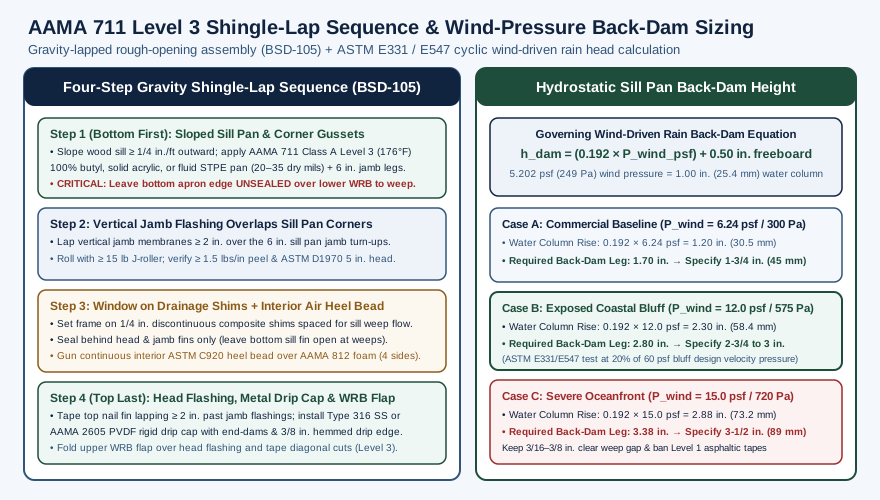
The Four-Step Gravity Shingle-Lap Sequence (BSD-105)
- Step 1 — Sloped Sill Pan (First): Bevel wood sills outward ≥ 1/4 in./ft (
2%). Adhere theAAMA 711 Level 3pan membrane across the sill, turning ≥ 6 in. up both jambs and lapping ≥ 2–4 in. over the lower WRB. Leave the bottom sill pan apron edge unsealed for drainage. - Step 2 — Jamb Flashing (Second): Lap vertical jamb strips ≥ 2 in. over the
6 in.sill pan jamb legs and extend ≥ 3 in. past sill and header lines; roll with a ≥ 15 lb J-roller. - Step 3 — Shims & Interior Heel Seal (Third): Set the frame on 1/4 in. discontinuous composite shims. Seal behind head and jamb fins only (leaving the bottom sill fin unsealed at weeps), and gun a continuous interior air-barrier heel bead (
ASTM C920overAAMA 812foam) on all four interior sides. - Step 4 — Head Flashing, Drip Cap & WRB Flap (Fourth): Tape the top fin lapping ≥ 2 in. past jamb flashings; install a
Type 316stainless orAAMA 2605PVDF drip cap with end-dams and a 3/8 in. hemmed drip edge; fold the upper WRB flap over the head leg and tape diagonal cuts.
Hydrostatic Sill Pan Back-Dam Height Under ASTM E331 / E547 Wind-Driven Rain
Coastal windows are tested under ASTM E331 (static) and ASTM E547 (cyclic pressure with 5.0 gal/ft²·hr spray). Because 1.00 in. (25.4 mm) of vertical water column equals 5.202 psf (249 Pa) (0.1922 in./psf), size vertical pan back-dam and end-dam height (h_dam) with a 0.50 in. turbulent freeboard:
Required Sill Pan Back-Dam Height (h_dam) = (0.192 × P_wind_psf) + 0.50 in.
Worked example (Commercial baseline vs. exposed bluff):
- Case A (
P_wind = 6.24 psf/300 Pa):h_dam = (0.192 × 6.24) + 0.50 = 1.70 in.→ specify a1-3/4 in.(45 mm) back-dam leg. - Case B (
PG60–PG80bluff atP_wind = 12.0 psf/575 Pa):h_dam = (0.192 × 12.0) + 0.50 = 2.80 in.→ specify a2-3/4 to 3 in.(70–76 mm) back-dam return. - Case C (
P_wind = 15.0 psf/720 Pa):h_dam = (0.192 × 15.0) + 0.50 = 3.38 in.(3-1/2 in.).
Keep a 3/16–3/8 in. (5–10 mm) weep gap above flashings, mount siding on vertical strips per our furring strips for rainscreen siding guide, and detail roof transitions per our parapet coping installation and joint review.
Takeaway: Detail every coastal rough opening with a 4-step gravity shingle-lap sequence (BSD-105), leave the bottom sill pan apron unsealed, and size upturned back-dams to h_dam = (0.192 × P_wind) + 0.50 in. (1-3/4 in. to 3-1/2 in.) paired with a continuous interior air heel seal.
4. Marine-Grade Fasteners, Structural Connectors, and Galvanic Isolation (AISI 316, ISO 9223 & FEMA TB-8)
Marine salt aerosols (NaCl and MgCl2) travel inland on onshore winds, enter vented rainscreen cavities, soffits, and crawlspaces, and deliquesce into conductive chloride brine above 70%–75% relative humidity.
Why AISI Type 304 and Galvanized Steel Fail Near Breaking Surf
Per the Specialty Steel Industry of North America (SSINA) Corrosion Reference and Simpson Strong-Tie’s Stainless-Steel Fastener Guidance, AISI Type 304 / 305 stainless steel (18% Cr, 8%–12% Ni, 0% Mo) suffers chloride pitting, crevice attack, and brown tea-staining in unwashed coastal crevices. AISI Type 316 / 316L marine-grade stainless steel (16%–18% Cr, 10%–14% Ni, 2.0%–3.0% Mo) adds molybdenum to stabilize the passive oxide film inside oxygen-depleted thread crevices.
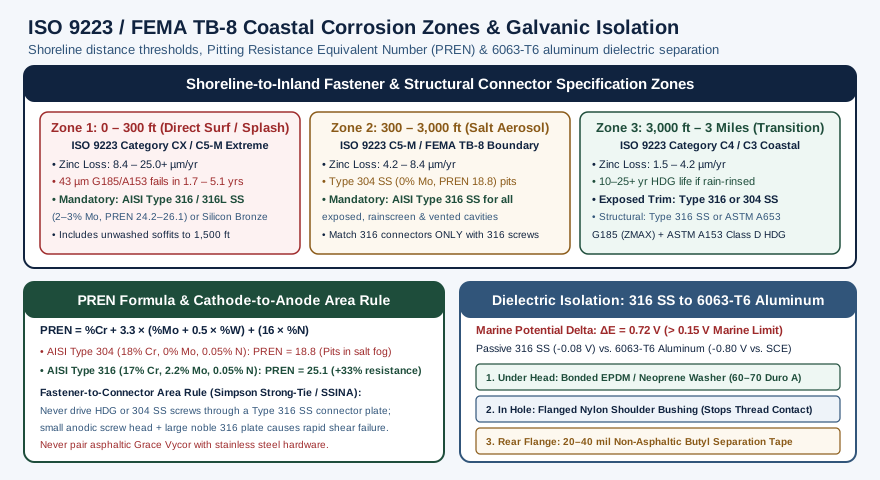
Alloy PREN & Sacrificial Zinc Depletion Formulas
Threshold rule: Require PREN ≥ 24.0 (AISI Type 316 / 316L) for all stainless hardware within the 3,000-foot coastal boundary defined by FEMA P-55 / Technical Bulletin 8 and Simpson Strong-Tie’s Wood Connectors & Fasteners Corrosion Classification:
Pitting Resistance Equivalent Number (PREN) = %Cr + [3.3 × (%Mo + 0.5 × %W)] + (16 × %N)
Galvanized Zinc Life (Years) = Zinc Thickness (µm) ÷ ISO 9223 Zinc Loss Rate (µm/yr)
Worked example (Type 304 vs. Type 316 PREN and G185 / A153 zinc life in ISO 9223 C5-M / CX surf zones):
- Alloy
PREN:Type 304(18% Cr, 0% Mo, 0.05% N) yieldsPREN = 18.8(pits in salt fog).Type 316(17% Cr, 2.2% Mo, 0.05% N) yieldsPREN = 25.06(33% higher pitting resistance). - Zinc Depletion: Light
ASTM A653 G90(~19 µmzinc/side) and heavyASTM A653 G185 / ZMAX(~39 µmzinc/side) orASTM A153 Class Dfasteners (~43 µmzinc) dissolve rapidly inISO 9223 C5-M(4.2–8.4 µm/yr) andCXsurf/crevice zones (8.4–25+ µm/yr). At12.6 µm/yr,G90rusts in19 ÷ 12.6 = 1.5 yearsand40 µmG185 / A153fails in40 ÷ 12.6 = 3.2 years.
Three Galvanic Isolation & Treated-Lumber Rules
- Never Mix
Type 304or HDG Fasteners withType 316Connectors: Driving a less-noble screw through a large nobleType 316connector plate creates an unfavorable cathode-to-anode area ratio (>> 10:1) that shears the screw head rapidly. Pre-drill pilot holes and use torque limiters to preventType 316galling. - Isolate
Type 316Stainless (-0.08 V) from6063-T6Aluminum (-0.80 V): The0.72 Vgalvanic delta (ΔE) exceeds the0.15 Vmarine limit. Isolate every connection with (a) a bondedEPDM/neoprene washer (60–70 Duro A), (b) a flanged nylon shoulder bushing, and (c) 20–40 mil non-asphaltic butyl or STPE separation tape. - Copper-Treated Wood (
ACQ,CA-C,MCA) & Barrier Membranes: Per our deck ledger flashing review record, useType 316hardware on coastal treated wood, separate metals with non-asphaltic butyl/EPDM membranes, and follow Simpson Strong-Tie’s prohibition against pairing asphalticGrace Vycorwith stainless steel.
Swipe or scroll horizontally to view all columns →
| Exposure Zone | ISO 9223 & FEMA TB-8 | Zinc Loss & Life | Mandatory Alloy | Galvanic Isolation |
|---|---|---|---|---|
Zone 1 (0–300 ft surf; soffits to 1,500 ft) |
ISO 9223 CX / C5-M; TB-8 Severe |
8.4–25+ µm/yr (G185 fails 1.7–5 yrs) |
AISI Type 316 SS (PREN 24.2–26.1) | EPDM washer + nylon bushing on Al; only 316 screws in 316 plates |
Zone 2 (300–3,000 ft shoreline) |
ISO 9223 C5-M / C4; 3,000-ft Rule | 4.2–8.4 µm/yr (G90 fails 2–4 yrs) |
AISI Type 316 SS for exposed & vented | 20–40 mil butyl/EPDM tape on ACQ wood (no asphaltic Vycor on SS) |
Zone 3 (3,000 ft–3 miles inland) |
ISO 9223 C4 / C3 | 1.5–4.2 µm/yr (10–25+ yr if rinsed) |
316/304 SS or G185 + A153 Class D |
Never drain bare copper onto Al or G185; keep dielectric break |
Takeaway: Enforce the FEMA Technical Bulletin 8 3,000-foot boundary by specifying AISI Type 316 / 316L stainless steel (PREN 24.2–26.1), matching Type 316 connectors exclusively with Type 316 fasteners, and isolating 6063-T6 aluminum with EPDM washers and nylon bushings.
Frequently Asked Questions
Why are STPE and neutral-cure silicone sealants preferred over polyurethane for coastal construction products?
Silyl-terminated polyether (STPE / MS polymer) and neutral-cure (alkoxy/oxime) silicones cure into a siloxane (Si-O-Si) network rated to ASTM C920 Class 50 (±50% movement) or Class 100/50 (+100% / -50%), per the WBDG Exterior Wall Systems Guide. Unlike Class 25 polyurethanes—which chalk under marine UV, hydrolyze in alkaline damp masonry, and outgas CO2 blisters above 4%–5% moisture—STPE and neutral-cure silicones resist UV cleavage, bond primerless to AAMA 2605 (70% PVDF) frames, and maintain low modulus (25–65 psi).
What does AAMA 711 Level 3 mean when selecting window flashing tape for coastal buildings?
Under FGIA / AAMA 711-22, Level 3 certifies that a self-adhered flashing membrane withstands 80°C (176°F) thermal exposure without slump or bleed, maintains ≥ 1.5 lbs/in (0.26 N/mm) peel adhesion, and passes ASTM D1970 nail sealability under a 5-inch water head at 40°F for 72 hours. Behind dark coastal cladding, Level 1 (50°C / 122°F) modified-bitumen tapes liquefy and leach plasticizers from PVC window fins.
How close to the ocean are AISI Type 316 stainless steel fasteners and connectors required?
Under FEMA P-55 / Technical Bulletin 8 and Simpson Strong-Tie’s coastal corrosion classification, AISI Type 316 / 316L stainless steel (2%–3% Mo, PREN 24.2–26.1) is required within 3,000 feet of breaking surf or tidal water (ISO 9223 Category C5-M and CX). In this zone, unwashed salt aerosols cause Type 304 (0% Mo, PREN 18.8) to pit and tea-stain and consume 40 µm hot-dip galvanized zinc (ASTM A653 G185 / A153 Class D) in 1.7 to 5.1 years.
How do you prevent galvanic corrosion between Type 316 stainless steel fasteners and aluminum window frames?
In marine salt spray, passive AISI Type 316 stainless steel (-0.08 V vs. SCE) and 6063-T6 / 5052-H32 aluminum (-0.80 V vs. SCE) develop a 0.72 V potential difference, per SSINA marine galvanic data. Isolate every stainless fastener from aluminum using a bonded EPDM/neoprene sealing washer under the head, a flanged nylon shoulder bushing inside the hole, and 20–40 mil non-asphaltic butyl or STPE separation tape behind the flange.
5. Submittal Verification & Field Adhesion Audit Checklist (ASTM C794 & ASTM C1521)
Before scaffolding is struck or drywall conceals rough openings, enforce a two-gate field audit coordinated with our rainy-climate construction guide:
- Substrate Moisture & Two-Cloth IPA Prep: Verify wood framing
≤ 19%moisture content (MC) by pin meter, cleanAAMA 2605(70% PVDF) frames with a two-cloth isopropyl alcohol (IPA) wipe, compress all flashing laps with a ≥ 15 lb J-roller, and verifyASTM F593 / F594 Group 2(Type 316) mill certificates on fastener boxes. - In-Situ Destructive Pull Testing (
ASTM C1521 Method A): Per the WBDG Exterior Wall Quality Assurance Protocol, test1joint per100 linear feet(LF) for the first1,000 LF(10 tests) and1per500 LFthereafter.
Threshold rule: After 7–14 days cure, cut a 3 in. (76 mm) sealant tail free from the backer rod, mark a 1.0 in. gauge length (L_initial), pull at 90° until stretched to 2.0 in. (100% elongation for Class 50), and hold for 60 seconds:
Field Pull-Tab Elongation (%) = [(L_stretched − L_initial) ÷ L_initial] × 100
Worked example (2,500 LF coastal storefront project): Testing 2,500 LF requires (1,000 ÷ 100) + (1,500 ÷ 500) = 13 logged pull tests. Stretching each 1.0 in. mark to 2.0 in. (100% elongation) for 60 seconds must yield 0.00 in. (0%) adhesive peel separation from either substrate before refilling the test cut with batch-matched sealant.
Swipe or scroll horizontally to view all columns →
| Gate | Standard | Evidence | Pass Threshold | Sign-Off |
|---|---|---|---|---|
| 1. Sealant | ASTM C920 & C1248 |
Data sheet + stain report | Class 50 / 100/50 STPE/silicone; 0 stain | Lot: ___ |
| 2. PVDF Peel | ASTM C794 & AAMA 2605 |
Lab peel on 70% PVDF | ≥ 5.0 pli; ≥ 75% cohesive | Rep: ___ |
| 3. Flashing | AAMA 711-22 & D1970 |
Butyl, acrylic, or STPE | Type A, Level 3 (176°F); 5-in. head |
Lot: ___ |
| 4. Sill Pan | BSD-105 & E331 / E547 |
Pre-window pan check | Slope ≥ 1/4 in./ft; h_dam ≥ 1.75–3.50 in. |
Loc: ___ |
| 5. Hardware | FEMA TB-8 & F593 |
Mill certs + washers | Type 316 SS (PREN ≥ 24.2); EPDM + nylon |
Cert: ___ |
| 6. Field Pull | ASTM C1521 Method A |
Pull log (1/100 LF) |
0.00 in. (0%) peel at 100% stretch (60 s) |
Pass: ___ |
Takeaway: Gate every coastal facade package on verified ASTM C794 lab peel reports (≥ 5.0 pli on AAMA 2605 PVDF), pre-application moisture checks (≤ 19% wood MC), and logged ASTM C1521 Method A field pull tests (0% adhesive separation at 100% elongation).
Related articles

Coastal Construction: Corrosion, Wind, Rain, and Maintenance
Map salt, rain, wind and flood exposure before selecting materials; verify connections and maintenance access before concealing work.
Read article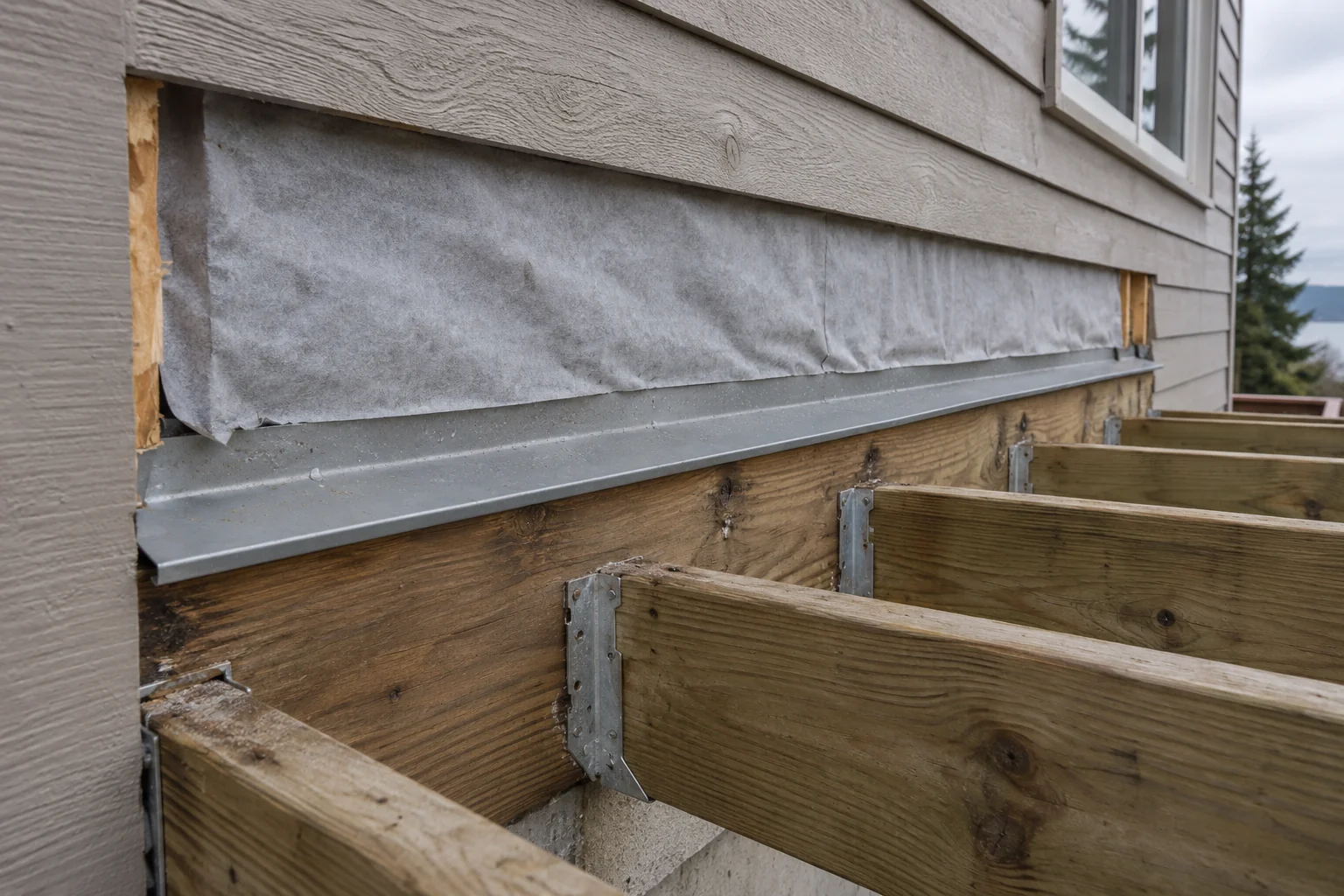
Deck Ledger Flashing Detail: A Rain and Coastal Review Record
Review the ledger water path, treated-wood and metal compatibility, and hidden damage. Copy a record for photos, product documents and closure decisions.
Read article
Building for Rainy Climates
Construction priorities for wind-driven rain, drainage, flashing, temporary protection, drying, and moisture verification in wet West Coast regions.
Read article