
Coastal Construction: Materials, Corrosion, Wind, Water, and Maintenance
A practical West Coast guide to salt exposure, corrosion, wind-driven rain, flood and wave context, exterior assemblies, and coastal maintenance.
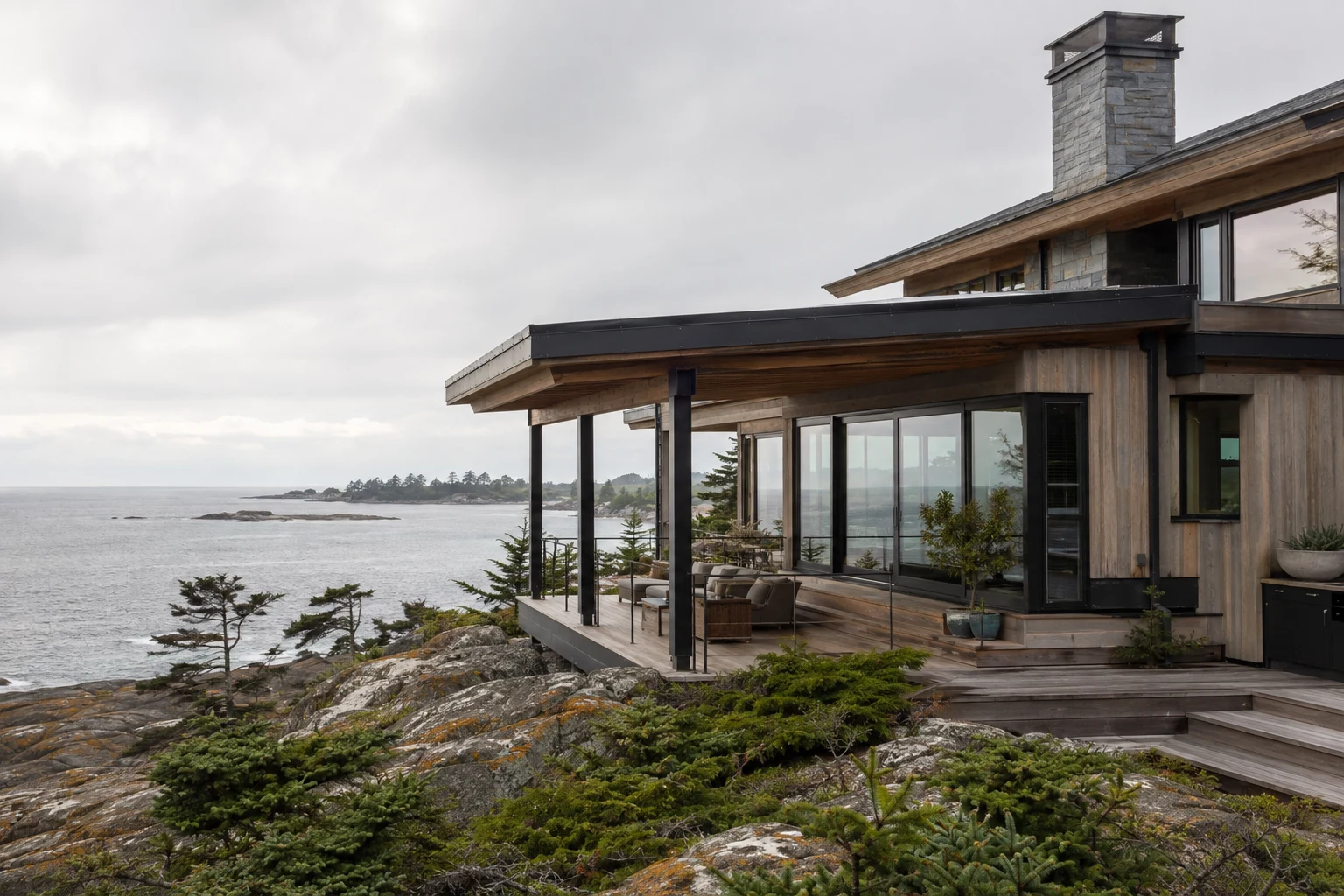
Coastal construction must respond to the actual site exposure: salt-laden air, wind-driven rain, ultraviolet light, sand, persistent dampness, high winds, flooding, waves, erosion, wildfire, and limited maintenance access can occur in different combinations. Durable work starts by mapping those hazards, then coordinating structure, enclosure, materials, utilities, construction sequencing, and inspection.
Key takeaways
- “Near the coast” is not a complete exposure specification; distance, elevation, wind, surf, shelter, and salt deposition all matter.
- Corrosion resistance is an assembly decision involving base metals, coatings, fasteners, connectors, cut edges, drainage, and dissimilar-metal contact.
- Wind-driven rain requires continuous water and air control, robust flashings, and pressure-aware detailing at openings and joints.
- Flood and wave design must follow current mapped hazards, adopted requirements, and qualified engineering.
- Coastal finishes need planned inspection, cleaning, repair access, and realistic replacement intervals.
- Use the Climate & Durability hub to coordinate coastal decisions with rain, moisture, wildfire, seismic, and regional conditions.
Define the coastal exposure before selecting products
A site a few blocks behind buildings and vegetation may receive a different salt and wind load from an exposed headland, bluff, marina, or beachfront property. Elevation, prevailing wind, storm direction, wave action, fog, humidity, temperature, and nearby industrial sources can change the corrosion environment.
Document the orientation and shielding of each facade. Roof edges, seaward elevations, balconies, exterior equipment, undercrofts, and horizontal ledges often receive more exposure than protected walls. Salt can also travel inland and accumulate where surfaces are rarely rinsed by rain.
The site assessment should identify mapped flood zones, design flood elevations, erosion or bluff constraints, tsunami information where relevant, high-wind criteria, geotechnical conditions, wildfire exposure, and emergency access. These are separate hazards. A building outside a mapped high-risk flood area can still face severe wind-driven rain and corrosion.
Treat corrosion as a system
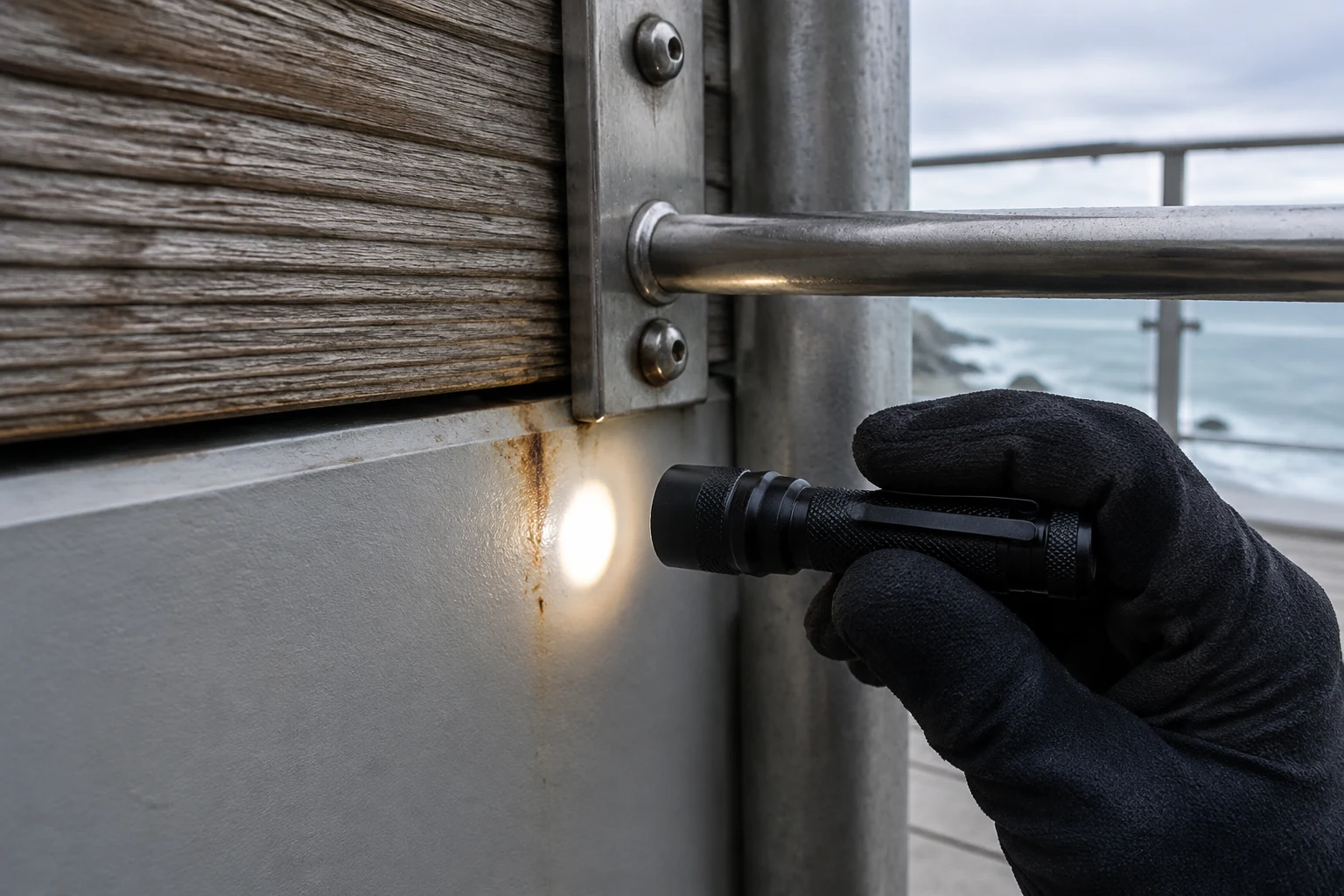
Corrosion occurs when a susceptible material, moisture, oxygen, and an electrolyte interact. Salt increases conductivity and can accelerate attack. Crevices, deposits, damaged coatings, cut edges, scratches, trapped water, and dissimilar metals can create concentrated deterioration.
Do not choose a fastener by a generic label alone. Confirm the base material, grade or alloy, coating, coating thickness where relevant, head and shank exposure, compatibility with the connected material, and suitability for the defined environment. Manufacturer literature, tested assembly requirements, structural specifications, and current code should agree.
Dissimilar metals can form a galvanic couple when electrically connected in the presence of moisture. Relative area matters: a small active-metal component connected to a large noble-metal surface may deteriorate quickly. Separation layers, compatible fasteners, drainage, coatings, and deliberate material pairings can reduce risk, but each connection should be reviewed.
Treated wood can also affect fastener and connector selection. Confirm the treatment chemistry and required corrosion protection. Do not assume that a concealed connector is protected; salt-laden air and wind-driven water can enter cavities and hardware pockets.
Design water paths for wind-driven rain
Coastal rain may be driven upward or sideways through joints that perform adequately in sheltered conditions. The exterior cladding should shed most water, while flashings and a continuous water-resistive barrier collect and direct incidental water outward. A continuous air barrier helps reduce pressure-driven flow through cracks.
Use shingled laps, end dams, back dams, sloped sills, head flashings, and durable terminations. Avoid relying on exposed sealant as the only line of defense where a drained detail is feasible. Sealants move, weather, and lose adhesion; joint geometry, substrate preparation, and access for replacement matter.
A defined cavity behind cladding can improve separation and drainage. The rainscreen wall systems guide covers cavity openings, attachments, windows, fire, insects, and quality assurance. At coastal sites, cavity components and fasteners require the same corrosion review as visible materials.
Coordinate the four control layers
The building envelope guide organizes exterior assemblies around water, air, vapor, and thermal control. Coastal exposure raises the consequence of discontinuities but does not change the basic logic.
Trace water and air control across walls, roofs, foundations, doors, windows, decks, canopies, parapets, penetrations, and utility entries. Review vapor and thermal control for the specific climate and interior humidity. A conditioned coastal building may experience both inward and outward vapor drives at different times.
Roof-to-wall transitions and openings deserve special attention. Overhangs can reduce direct wetting but must be designed for wind forces and wildfire context. Sliding doors, large windows, and recessed balconies create long joints and complex sill conditions. Plan how water that enters a frame or track reaches the exterior without wetting concealed finishes.
Select cladding by exposure and repair strategy
The best coastal cladding is not simply the product with the most aggressive durability claim. Evaluate the complete wall: support system, finish, fasteners, cut edges, joints, drainage, movement, impact, ultraviolet exposure, cleaning, recoating, and replacement access.
Metal panels can provide crisp, low-absorption surfaces, but alloy, coating system, scratches, edges, fasteners, and runoff between metals matter. Fiber-cement products can resist many decay mechanisms, while cut edges, clearances, joints, fasteners, finish condition, and moisture management still govern performance. Wood offers repairable, familiar construction but needs species-appropriate detailing, coating or weathering expectations, end-grain protection, ventilation, and routine inspection.
Masonry and stucco can store water and may expose embedded metals or adjacent assemblies to prolonged moisture. Vinyl and polymer products avoid metal corrosion in the cladding itself but still depend on compatible fasteners, movement clearances, wind resistance, and a durable wall behind them.
Compare these families in the exterior cladding guide and siding guide. Use samples and mockups to judge weathering, staining, texture, glare, and repair appearance rather than selecting from a small clean sample alone.
Design attachments for wind and corrosion
Cladding, roofing, rooftop equipment, solar arrays, railings, canopies, decks, and screens must transfer wind loads to adequate structure. Corners, roof edges, parapets, and exposed elevations can receive higher pressures than field areas. Attachment design should use the project wind criteria, component approvals or engineering, substrate capacity, edge distances, and installation tolerances.
Every fastener through the water-control layer is also an enclosure event. Coordinate clips, rails, furring, blocking, gaskets, sealants, and membranes so structural load paths do not create uncontrolled water paths. Exterior insulation changes fastener geometry and may introduce thermal bridging or compression.
Avoid creating pockets that retain salty water. Provide drainage and ventilation where appropriate, slope horizontal surfaces, close vulnerable tube ends, and make inspection possible. Protective caps and covers should shed water without trapping condensation.
Address flood, waves, and erosion with current requirements
Flood-resistant design is location-specific and life-safety critical. Establish the applicable flood zone, design flood elevation, wave conditions, foundation requirements, permitted enclosure below elevated floors, flood-damage-resistant materials, utility elevation, and debris exposure from current authoritative sources and the local jurisdiction.
In high-hazard coastal areas, wave action and moving water can impose forces beyond still-water flooding. Foundations, breakaway construction where applicable, scour, erosion, and the path of water and debris require qualified coastal, structural, civil, and geotechnical input.
Do not use this article to infer a required elevation or foundation type. FEMA coastal manuals provide valuable principles, but adopted maps, codes, amendments, site studies, and project-specific design control the work.
Protect utilities and building services
Salt and water affect outdoor condensers, heat pumps, electrical equipment, generators, controls, lighting, fasteners, screens, ducts, louvers, and rooftop systems. Locate equipment to reduce direct spray and flood exposure without blocking service access or required airflow.
Coordinate manufacturer coastal-use guidance, coatings, anchorage, disconnects, penetrations, condensate disposal, and replacement routes. A protective enclosure that restricts heat rejection or traps salt can shorten equipment life.
Where flooding is possible, place critical equipment and controls above the required elevation and route utilities in accordance with current regulations and professional design. Backflow, emergency power, fuel systems, sewer connections, and safe shutdown need project-specific planning.
Manage coastal construction conditions
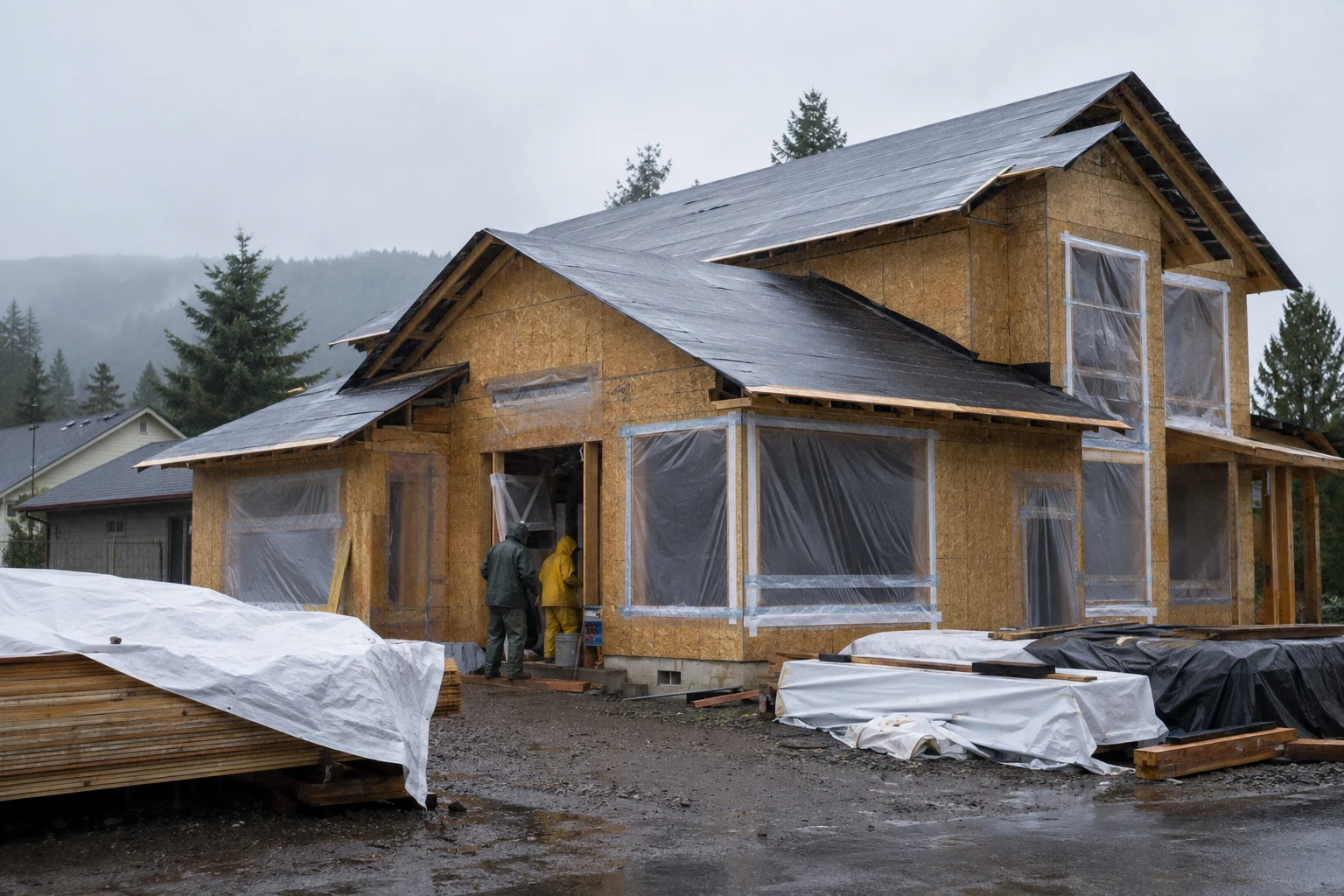
Salt contamination, wind, fog, rain, and rapid weather changes can affect coating adhesion, sealants, membranes, welding, concrete curing, and stored materials. Establish acceptable temperature, humidity, surface moisture, wind, and cleanliness conditions from product requirements.
Protect metals from grinding debris and incompatible runoff. Repair coating damage using the specified system, not an arbitrary field paint. Store fasteners and connectors dry and labeled so similar-looking grades are not mixed. Cover moisture-sensitive materials while allowing ventilation that avoids condensation under tarps.
Use mockups to establish substrate preparation, joint geometry, coating touch-up, flashing, fastener appearance, and cleaning. Inspect concealed flashings and connectors before cladding closes the cavity. The rainy-climate construction guide adds temporary protection and moisture-verification steps.
Build maintenance into the design
Coastal durability depends on recurring care. Create an exposure-based inspection plan for coatings, cut edges, fasteners, sealants, joints, railings, flashings, drains, rooftop equipment, screens, and concealed drainage exits. Seaward and horizontal surfaces may need more frequent attention than sheltered elevations.
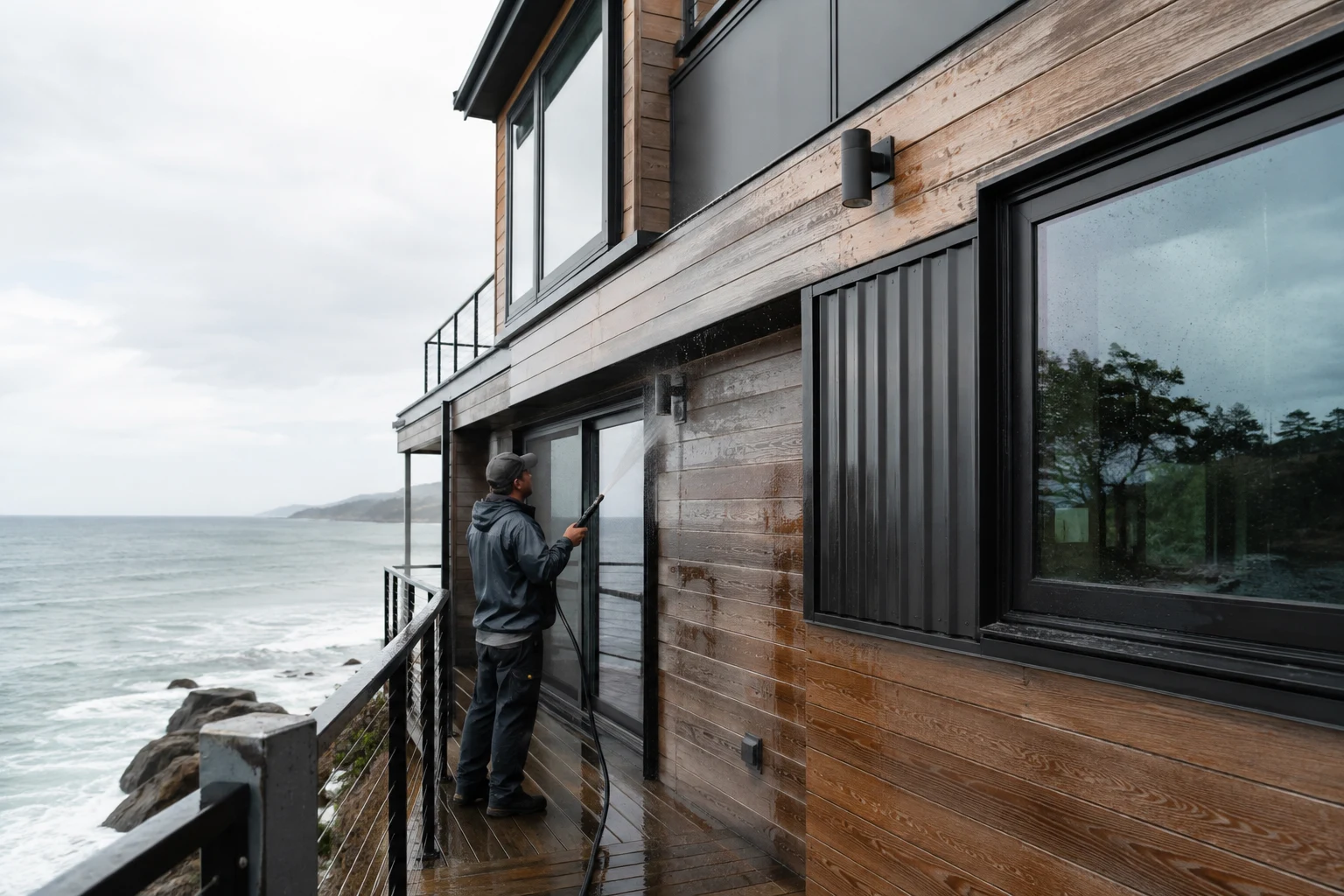
Cleaning can remove salts, but the method must be compatible with finishes, joints, landscaping, runoff rules, and manufacturer instructions. Aggressive pressure washing can drive water behind cladding or damage coatings. Document approved cleaners, water pressure, access method, and rinse requirements.
Investigate rust staining rather than only cleaning it. The source may be an unprotected fastener, embedded metal, damaged coating, incompatible runoff, or concealed connection. Early localized repair is usually easier than widespread replacement after section loss or staining spreads.
Coastal construction checklist
- Document wind, salt, rain, flood, wave, erosion, wildfire, and geotechnical context
- Map exposed and sheltered elevations separately
- Specify compatible fasteners, connectors, coatings, and separation materials
- Detail drainage and air-control continuity at every transition
- Verify wind load paths for cladding, roofing, equipment, and projections
- Protect cut edges, scratches, welds, and field modifications
- Elevate or protect utilities according to current requirements
- Use mockups and inspect concealed work before closure
- Provide cleaning, inspection, repair, and replacement access
- Record materials and accepted field repairs in closeout documents
Common questions
Is stainless steel always safe near the ocean?
No material is universally immune. Stainless performance varies by alloy, finish, fabrication, crevices, contamination, cleaning, and exposure. Select it as part of a documented corrosion strategy and confirm compatibility with connected materials.
How far inland does salt exposure matter?
There is no single distance. Wind, surf, elevation, shielding, fog, and local geography affect deposition. Use site observation, regional experience, manufacturer exposure criteria, and professional judgment.
Does a rainscreen prevent coastal leaks?
It can improve drainage and separation, but it does not compensate for failed flashings, discontinuous water or air control, blocked outlets, or unsuitable attachments.
Can ordinary maintenance overcome an unsuitable material?
Maintenance can preserve a well-chosen system, but unrealistic cleaning, recoating, or access assumptions often become deferred work. Select materials whose required care matches the owner’s resources and exposure.
Sources and limitations
This guide was reviewed against FEMA’s Coastal Construction Manual, Volume I, Coastal Construction Manual, Volume II, and Home Builder’s Guide to Coastal Construction, plus the NIST coastal corrosion context.
Coastal structure, flood, wave, erosion, fire, corrosion, and code decisions require current local data and qualified professionals. Conditions and product requirements change; verify them for the project.
Related articles
Building for Rainy Climates
Construction priorities for wind-driven rain, drainage, flashing, temporary protection, drying, and moisture verification in wet West Coast regions.
Read article
Moisture Control in Buildings: Design, Construction, and Maintenance
A practical guide to controlling rain, groundwater, air leakage, vapor, plumbing leaks, and construction moisture in durable buildings.
Read article
Exterior Cladding Guide for West Coast Buildings
How to compare exterior cladding by climate exposure, drainage, structure, fire context, installation, maintenance, repairability, and total project fit.
Read article