
Selecting Commercial Construction Management Companies
How to evaluate commercial construction management companies across California, Oregon, and Washington: Agency CM vs. CMAR/GMP delivery, ASCE 41 seismic and Title 24/WSEC-C alteration triggers, wet-season moisture gates, and schedule claim audits.
Selecting among construction management companies for a West Coast commercial build-out, structural upgrade, or occupied facility renewal requires auditing how each firm structures contract risk, models existing-building code triggers, protects open envelopes during winter rain, and documents schedule delays. Awarding a contract on fee percentage alone causes costly rework, permit review stalls, and mid-project downtime when an unvetted team misses mandatory seismic, accessibility, or energy upgrades during preconstruction.
This selection framework sits within the Commercial Construction hub and the commercial construction category archive. Pair these pre-award qualification gates with the post-award baseline and decision registers in our commercial construction management guide and the tenant coordination checklists in our commercial renovation planning guide.
- Match delivery structure to internal staffing: Hire an Agency Construction Manager (CMa) for independent, fee-based representation without trade subcontracts, or a Construction Manager at Risk (CMAR / CMc) to lead preconstruction and lock a Guaranteed Maximum Price (GMP) backed by open-book subcontractor buyout.
- Require a preconstruction Code-Trigger Matrix: Verify how candidate commercial construction management teams model structural alterations (IEBC / CEBC 10% lateral demand-capacity and 5% strength-reduction rules), ADA path-of-travel obligations (
28 CFR § 36.403vs. California CBC Section 11B-202.4), and state energy codes (Title 24 Part 6 and WashingtonWSEC-C) before fixing the GMP. - Prequalify seismic and envelope specialists early: When reroofing, cutting floor openings, or changing occupancy in older concrete tilt-up, unreinforced masonry, or soft-story buildings, confirm that the CM prequalifies a specialized seismic retrofit contractor and coordinates IBC Chapter 17 special inspections.
- Audit October–April field discipline: Review each finalist’s written moisture-control plan (wood framing ≤ 19% moisture content and ASTM F2170 concrete slab relative humidity hold points) alongside its NPDES / SWRCB 250 NTU turbidity and 6.5–8.5 pH compliance logs.
- Inspect three-year closeout and claim records: Demand redacted closeout logs from three comparable commercial projects showing initial GMP versus final contract sum, contractor-initiated change orders, and 10-year NOAA weather-float calculations.
Swipe or scroll horizontally to view all columns →
| Evaluation Gate | Statutory or Contractual Standard | Evidence Required from Candidate CM Firms | Dominant Failure Mode & Prevention |
|---|---|---|---|
| 1. Delivery & GMP Buyout | WBDG Project Delivery Teams & FHWA CM/GC Framework | Sample GMP amendment showing 3+ sealed bids per trade, separated contingencies, and Early Work Package (EWP) gates | Hidden self-perform markups and contingency commingling → require open-book bid tabs and written owner approval |
| 2. Structural & Seismic Triggers | California Title 24 Part 10 (CEBC) / IEBC Ch. 5 & ASCE 41 | Preconstruction structural check (>5% gravity load, >10% lateral demand-capacity ratio, or >5% lateral strength loss) and prequalified seismic retrofit contractor bench | Unbudgeted diaphragm re-nailing or collector upgrades flagged in plan check → run destructive investigation and SEOR review early |
| 3. Accessibility Path of Travel | 28 CFR § 36.403 & California CBC § 11B-202.4 | Line-item path-of-travel budget applying the 20% federal cap (OR/WA) or California annual valuation threshold check | Permit hold over non-compliant restrooms or lobbies → price the five-step federal priority sequence before finalizing TI budgets |
| 4. Energy Code Alterations | California Title 24 Part 6 & Washington WSEC-C (WAC 51-11C) Ch. 5 | Envelope and mechanical trigger review covering continuous roof deck insulation, LPA cuts, and HVAC economizer / DOAS / TSPR rules | Roof tear-off triggers thicker insulation that buries parapet flashing and RTU curbs → check curb heights and dead load in preconstruction |
| 5. Wet-Season & SWPPP Controls | EPA Moisture Guidance (402-F-13053), EPA 2022 CGP & CA Order WQ 2022-0057-DWQ | Past project “Permission to Conceal” wood/concrete moisture logs plus QSD/QSP stormwater logs verifying turbidity ≤ 250 NTU and pH 6.5–8.5 | Wet framing enclosed behind drywall or turbid dewatering stop-work order → enforce pin-meter hold points (≤ 19% MC) and active treatment |
| 6. Schedule Float & Claim Hygiene | Logic-linked Critical Path Method (CPM) & Time Impact Analysis (TIA) | Baseline CPM schedule with 10-year NOAA monthly precipitation bank and 3-project GMP-to-closeout variance log | Inflated delay claims after routine winter storms → limit excusable delays to days exceeding the 10-year NOAA norm on the critical path |
1. Match the Delivery Model to Your Risk Profile: Agency CM vs. CM at Risk (CMAR)
Before issuing a Request for Proposals (RFP), commercial owners and asset managers must decide whether to hire a construction management firm as a fiduciary advisor or at-risk builder. Blurring these structures leads to overlapping fees, ambiguous change-order authority, and unexamined trade pricing.
Agency Construction Management (CMa): Pure Owner Representation
Under the delivery taxonomy established by the National Institute of Building Sciences Whole Building Design Guide (WBDG), an Agency Construction Manager (CMa) operates strictly as an extension of the owner’s staff under a professional services fee. The Agency CM holds no direct contracts with trade subcontractors or suppliers and assumes no financial liability for construction cost overruns or trade schedule performance.
Instead, the owner holds direct contract privity with both the design team and the prime general contractor. An Agency CM adds the highest value on complex capital programs—such as campus modernizations, medical office conversions, or phased occupied renovations—when the owner lacks internal project staff. Because the CMa has no financial stake in self-performing trade work, the firm provides an unbiased Independent Cost Estimate (ICE), audits schedule logic, and verifies change-order entitlement.
Construction Manager at Risk (CMAR / CMc): Two-Phase Preconstruction and GMP Execution
By contrast, a Construction Manager at Risk (CMAR)—designated as CMc in AIA contracts or CM/GC in the Federal Highway Administration (FHWA) CM/GC contracting manual—combines early preconstruction consulting with at-risk general contracting under a two-phase contract:
- Phase 1 — Preconstruction Services: Hired during schematic design on a fixed fee, the CMAR performs constructability reviews, destructive investigations, multi-code trigger modeling, phased occupancy logistics, and iterative estimating at 30%, 60%, and 90% design milestones.
- Phase 2 — Guaranteed Maximum Price (GMP) Amendment & Construction: When drawings reach 75% to 90% construction documents, the CMAR submits a GMP proposal. Once executed, the CMAR transitions from advisor to constructor, holds direct trade subcontracts, and absorbs cost overruns above the GMP cap (excluding owner-directed scope additions or contractually defined differing site conditions).
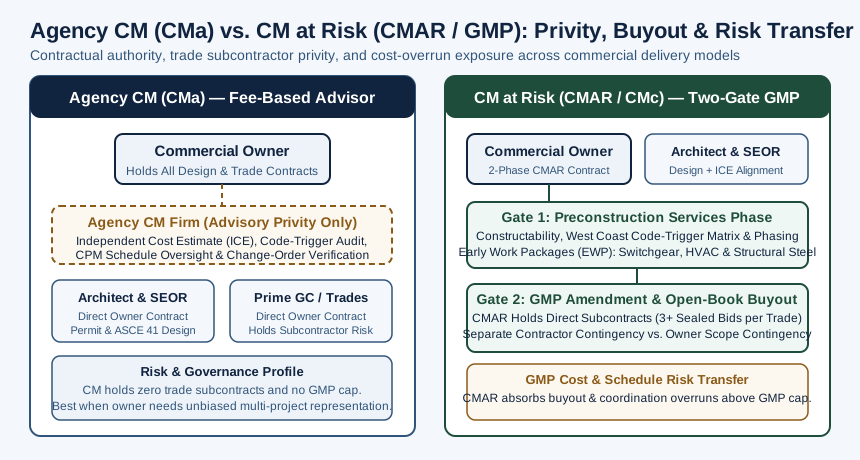
Three GMP Audit Rules When Interviewing CMAR Companies
When evaluating construction management companies proposing a CMAR/GMP structure, audit how their standard contract handles buyout transparency, contingency separation, and early procurement:
- Open-Book Subcontractor Buyout and Self-Perform Safeguards: Require the CMAR to solicit at least three sealed subcontractor bids per trade division and share unedited bid tabs with the owner. If the CMAR wishes to self-perform a trade package (such as selective demolition, carpentry, or concrete), it must submit its sealed bid 24 hours before competitor trade bids are opened and obtain written owner sign-off using our contractor bid comparison worksheet.
- Three-Bucket Contingency Separation: Follow the FHWA CM/GC risk-allocation structure by separating: (1) Design / Estimating Contingency (retired at GMP lock), (2) Contractor Construction Contingency (held inside the GMP—typically 2% to 3.5% of direct trade cost—for buyout gaps and trade coordination, with monthly draw logs and a shared-savings split at closeout), and (3) Owner Scope Contingency (held outside the GMP under sole owner signature).
- Early Work Package (EWP) Release Protocol: Because 480V/277V switchgear, transformers, custom rooftop Dedicated Outdoor Air Systems (DOAS), and structural steel carry 24- to 48-week lead times, verify that the CMAR can issue bonded Early Work Packages at 50% design development without forcing a premature GMP on interior finishes.
Swipe or scroll horizontally to view all columns →
| Delivery Attribute | Agency CM (CMa) | CM at Risk (CMAR / CMc / GMP) | Traditional Design-Bid-Build (DBB) |
|---|---|---|---|
| Contract Privity with Trades | None; owner contracts with prime GC | CMAR holds all trade subcontracts after GMP | Prime GC holds all trade subcontracts |
| Timing of CM Onboarding | Project inception / pre-design | Schematic design (20%–30% design) | After 100% construction documents |
| Preconstruction & ICE | Independent cost estimating (ICE) & advocacy | Iterative estimating, VE, and EWP buyout | None from builder during design |
| Subcontractor Pricing | Full audit access on owner’s behalf | Open-book bid tabs (3+ bids per division) | Closed lump-sum bid; markups opaque |
| Cost Overrun Liability | Remains with prime GC / owner | CMAR absorbs overruns above GMP cap | Prime GC absorbs base scope; claims gaps |
| Best-Fit West Coast Profile | Multi-site rollouts & institutional programs | Occupied renovations, seismic & lab retrofits | Simple, repeatable ground-up buildings |
Takeaway: Choose Agency CM when you need an independent advocate to police cost and schedule across prime contracts; choose CMAR with an open-book GMP protocol when concealed conditions, long-lead MEP equipment, and phased occupancy require builder input during design.
2. Audit How Candidate Firms Model West Coast Alteration Code Triggers
In Seattle (SDCI), Portland (PPD), San Francisco (DBI), and Los Angeles (LADBS), commercial renovation budgets fail during plan check when a commercial construction management team prices only the architect’s schematic interior layout without modeling the synchronized code-trigger cascade across structural seismic, accessibility, and energy regulations.
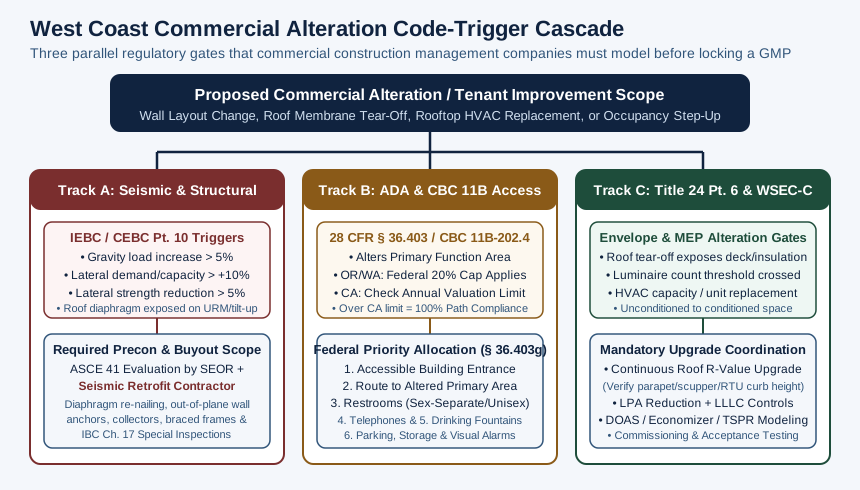
Track A — Structural & Seismic Triggers (CEBC Title 24 Part 10, IEBC & ASCE 41)
Across California, Oregon, and Washington, existing building alterations are governed by the International Existing Building Code (IEBC) and, in California, the California Existing Building Code (CEBC, Title 24 Part 10). During preconstruction interviews, test whether candidate construction managers screen every alteration scope against three numeric structural thresholds:
- The 5% Gravity Load Rule: If new rooftop units, storage, or thicker roofing assemblies increase design gravity loads on any framing member, column, or footing by more than 5%, that element must be evaluated and strengthened to current gravity load combinations.
- The 10% Lateral Demand / 5% Lateral Capacity Rule: Under IEBC and CEBC Chapter 5 (and Section 304), if an alteration increases the demand-capacity ratio on any lateral-force-resisting element by more than 10%, or decreases the lateral capacity of a structural element (such as cutting a stairwell or duct opening through a diaphragm) by more than 5%, the structure triggers a seismic evaluation and retrofit under the current code or ASCE/SEI 41.
- Roof Diaphragm Exposure & Occupancy Step-Ups: Stripping a roof membrane down to the structural deck on an unreinforced masonry (URM) or pre-1997 concrete tilt-up building triggers diaphragm edge re-nailing, crossties, and wall-to-diaphragm tension anchors under local ordinances or CEBC Appendix Chapter A1/A2. Stepping up to a higher Risk Category occupancy also triggers seismic evaluation.
When to Prequalify a Specialized Seismic Retrofit Contractor: For tilt-up wall anchorage, soft-story steel frames, fiber-reinforced polymer (FRP) collector wrapping, or micropile underpinning, require the CM firm to bring a prequalified seismic retrofit contractor into Phase 1 preconstruction to scope ferroscan rebar locating, concrete core testing, and wood sill inspections before pricing the GMP. See our seismic retrofit methods and load-path guide and earthquake retrofit cost and scope factors to align structural details, IBC Chapter 17 special inspections, and bid packages.
Track B — Accessibility Path-of-Travel Triggers (28 CFR § 36.403 vs. California CBC 11B-202.4)
Whenever a commercial alteration affects an area containing a primary function—such as a sales floor, office work area, medical suite, or dining room—accessibility mandates require upgrading the path of travel serving that area, with a critical split between Oregon/Washington and California:
- Federal ADA Title III Rule (
28 CFR § 36.403) — Oregon & Washington: Under 28 CFR § 36.403(f)(1), path-of-travel upgrades are disproportionate when their cost exceeds 20% of the primary function alteration cost. Under28 CFR § 36.403(g), that 20% budget must be spent in strict five-tier priority order: (1) accessible entrance, (2) accessible route to the altered area, (3) at least one accessible restroom for each sex or a unisex restroom, (4) telephones, and (5) drinking fountains, followed by parking, storage, and alarms. - California Building Code Chapter 11B (
CBC Section 11B-202.4) — Valuation Threshold Split: Under California Title 24 Part 2, Chapter 11B, projects at or below California’s annual valuation threshold cap path-of-travel upgrade costs at 20% of adjusted alteration cost. Projects exceeding the valuation threshold must bring the entire serving path of travel into 100% compliance regardless of cost, unless the local building department grants an Unreasonable Hardship finding.
Threshold rule: Isolate the primary-function alteration cost during preconstruction and calculate the mandatory 20% Path-of-Travel Disproportionality Allocation before pricing elective finishes:
Path-of-Travel Budget = 0.20 × Primary Function Alteration Cost
Worked example (Portland or Seattle office build-out under 28 CFR § 36.403): Suppose an owner budgets $420,000 for an office reconfiguration. The mandatory path-of-travel allocation is 0.20 × $420,000 = $84,000. If upgrading the entry door operator ($14,000), corridor hardware ($8,000), two core restrooms ($78,000), and a drinking fountain ($9,000) totals $109,000, the CM follows 28 CFR § 36.403(g) by funding Priority 1 ($14,000) and Priority 2 ($8,000), and applying the remaining $62,000 to Priority 3 (converting one compliant restroom).
Track C — Commercial Energy Code Triggers (California Title 24 Part 6 & Washington WSEC-C)
State commercial energy codes—California Title 24 Part 6 and Chapter 5 of the Washington State Energy Code – Commercial (WSEC-C, WAC 51-11C)—create two major preconstruction triggers:
- Roof Replacement Exposing the Deck or Insulation: Under Title 24 Part 6 and
WSEC-CSection C503.3, tearing off a low-slope roof membrane and exposing the deck or insulation triggers continuous above-deck rigid insulation meeting current R-value tables. A qualified CM checks three knock-on effects before pricing: (1) whether thicker insulation reduces parapet height below the 30-inch OSHA/IBC guard limit or buries scuppers, (2) whether rooftop HVAC curbs and skylights must be raised and re-flashed (see our building envelope control-layer guide), and (3) whether added weight crosses the 5% gravity load trigger on roof joists. - Lighting and Space-Conditioning Alterations: Altering a threshold share of luminaires triggers Lighting Power Allowance (LPA) cuts and Luminaire-Level Lighting Controls (LLLC). Replacing rooftop HVAC units in Washington or California can trigger Dedicated Outdoor Air System (DOAS) ventilation decoupling, heat-pump heating, or Washington’s Total System Performance Ratio (TSPR) modeling.
Takeaway: Require candidate firms to walk through a written three-track Code-Trigger Matrix (Seismic/Structural, ADA/CBC 11B, and Title 24/WSEC-C) during preconstruction before locking a GMP amendment.
3. Evaluate Wet-Season Temporary Protection and Stormwater (SWPPP) Execution
From October through April, atmospheric rivers across the Puget Sound, Willamette Valley, and coastal California turn poorly managed commercial jobsites into moisture and environmental liabilities. As detailed in our Pacific Northwest construction guide and rainy-climate construction and moisture verification guide, vetting construction management companies requires inspecting their field controls for rainwater exclusion, pre-concealment moisture testing, and stormwater discharge.
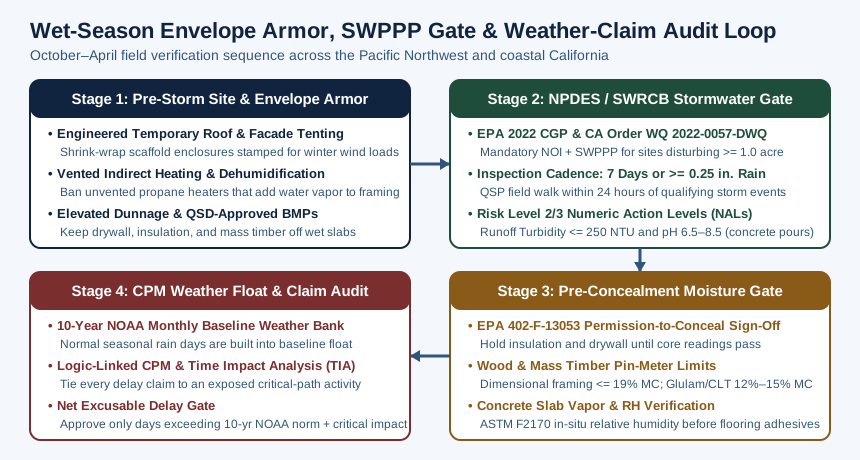
Temporary Weather Enclosure & Pre-Concealment Moisture Hold Points (EPA 402-F-13053)
In Moisture Control Guidance for Building Design, Construction and Maintenance (EPA 402-F-13053), the U.S. EPA establishes in Chapter 3 and Appendix C that visual surface dryness never proves a porous assembly is dry enough to enclose. Require shortlisted CM firms to provide a Construction Moisture Management Plan and signed field logs from a prior wet-season build demonstrating four controls:
- Engineered Temporary Roof and Facade Tenting: Carry an explicit allowance for wind-rated shrink-wrap scaffold tenting, heat-welded roof membranes, and drainage diverters before winter demolition starts.
- Vented Indirect Heating and Dehumidification: Ban unvented propane heaters (which release 1.6 lb of water vapor per pound of fuel) in favor of vented indirect-fired heaters and commercial dehumidifiers.
- Elevated Dunnage and Sequenced Delivery: Deliver gypsum board, batt insulation, acoustical tiles, and engineered wood only after dry-in and store them on elevated dunnage off damp slabs.
- Formal “Permission to Conceal” Hold-Point Logs: Under EPA 402-F-13053 Appendix C, log moisture readings before authorizing insulation, drywall, or flooring installation:
- Dimensional Wood Framing & Sheathing: Pin-type moisture meter readings at core depth must verify ≤ 19% moisture content (MC) before cavity closure.
- Cross-Laminated Timber (CLT) & Glulam Mass Timber: Manufacturer equilibrium limits of 12% to 15% MC at spline joints and beam seats.
- Concrete Floor Slabs: In-situ relative humidity testing per ASTM F2170 (or calcium chloride testing per ASTM F1869) confirming slab moisture is within adhesive limits.
Stormwater General Permit Compliance (2022 NPDES CGP & California Order WQ 2022-0057-DWQ)
On commercial sites disturbing 1.0 acre or more (or smaller sites within a common plan), stormwater runoff is regulated under the Clean Water Act U.S. EPA 2022 NPDES Construction General Permit (CGP) and state permits including California’s SWRCB Order WQ 2022-0057-DWQ. Verify two field compliance protocols during CM interviews:
- Inspection Cadence (
7 Calendar Daysor24 HoursPost-Storm): Under the EPA 2022 CGP, qualified personnel must inspect perimeter sediment controls, drain inlet protection, stabilized exits, and concrete washouts every 7 calendar days, or within 24 hours of a ≥ 0.25-inch rain event. - California QSD / QSP Roles & Numeric Action Levels (NALs): Under California Order WQ 2022-0057-DWQ, the SWPPP must be prepared by a Qualified SWPPP Developer (QSD) and overseen daily by a Qualified SWPPP Practitioner (QSP). For Risk Level 2 and 3 sites, the QSP monitors runoff against two Numeric Action Levels: daily average turbidity exceeding 250 NTU and pH outside 6.5 to 8.5 during concrete pours or dewatering.
Takeaway: Require candidate firms to submit redacted moisture hold-point logs (≤ 19% wood MC and ASTM F2170 concrete RH) and QSP stormwater inspection reports (≤ 250 NTU turbidity and pH 6.5–8.5) from a completed winter project before shortlisting them for an October–April build.
4. Forensic Audit of Schedule Baselines, Weather Float, and Delay Claims
A construction manager’s discipline shows up when an equipment delay, permit comment, or winter storm hits the schedule. Weak firms manage commercial jobs off static bar charts, overwrite baseline dates, and submit broad claims for “rain delays.”
10-Year NOAA Weather Banks vs. Excusable Delay Claims
In Western Washington, Western Oregon, and Northern California, winter rain is a known seasonal condition. Audit how each candidate CM defines adverse weather delays:
- Baseline Weather Float: A qualified West Coast CM builds a monthly Contract Weather Bank from the 10-year NOAA historical average of precipitation days directly into exterior activity durations.
- Two-Part Excusable Delay Gate: An excusable time extension requires (1) actual rain days in a month exceeding the 10-year NOAA baseline, and (2) a logic-linked Time Impact Analysis (TIA) proving the excess rain halted an unprotected critical-path activity with zero total float.
Threshold rule: Calculate Net Excusable Weather Delay Days only after subtracting the 10-year NOAA monthly baseline bank from verified critical-path rain-stoppage days:
Net Excusable Weather Days = Critical-Path Rain Stoppage Days − 10-Year NOAA Monthly Baseline Days
Worked example (Seattle commercial shell & roof renewal in November): With a Seattle-Tacoma Airport (KSEA) 10-year NOAA baseline of 11 workdays of rain (≥ 0.10 in.) in November, suppose rain falls on 16 workdays, halting critical-path roof deck welding and membrane work on 13 workdays (while crews worked indoors on switchgear for 3 days). Subtracting the 11-day baseline (13 − 11 = 2 net excusable workdays) yields 2 excusable workdays rather than a 16-day extension.
Critical Path Method (CPM) Hygiene & Past Project Closeout Logs
Per our commercial construction management guide, require a logic-linked Critical Path Method (CPM) schedule tying every plan-check window, utility shutdown, landlord sign-off, long-lead submittal, and IBC Chapter 17 special inspection to predecessors and successors. Also require a 3-Project Historical Variance Log from the last 36 months showing: (1) initial GMP vs. final sum, (2) owner vs. contractor change orders, (3) planned vs. actual occupancy dates, and (4) any unresolved liens or claims.
Takeaway: Tie contract weather extensions to a 10-year NOAA monthly precipitation baseline verified by a critical-path Time Impact Analysis, and verify a candidate CM’s real change-order behavior through redacted three-project closeout logs before award.
5. Copyable RFP & Interview Scorecard for Selecting Construction Management Companies
Use the weighted normalization scorecard below—alongside our contractor bid comparison worksheet—to evaluate shortlisted construction management companies on technical governance, regional code fluency, and field controls. Score each firm from 1 (unverified) to 5 (documented past-project evidence).
Swipe or scroll horizontally to view all columns →
| Evaluation Category & Weight | Specific Audit Requirement & Deliverable | Firm A (1–5) | Firm B (1–5) | Firm C (1–5) | Verification Notes & Red Flags |
|---|---|---|---|---|---|
| 1. Delivery & GMP (20%) | Open-book buyout (3+ bids/division), separated contingencies, and staffing-matrix General Conditions | ___ / 5 | ___ / 5 | ___ / 5 | Reject proposals blending contractor contingency with trade allowances |
| 2. Code-Trigger Matrix (25%) | CEBC/IEBC structural rules (+5% gravity, +10% lateral demand / -5% capacity), ADA 20% (28 CFR § 36.403) vs. CBC 11B, and Title 24 / WSEC-C triggers |
___ / 5 | ___ / 5 | ___ / 5 | Verify whether the firm flagged parapet height, RTU curbs, and restroom priority |
| 3. Seismic & Phasing (15%) | Named seismic retrofit contractor partners, IBC Ch. 17 special inspections, and utility/egress shutdown protocols | ___ / 5 | ___ / 5 | ___ / 5 | Check references for night/weekend structural tie-in work in occupied buildings |
| 4. Wet-Season & SWPPP (20%) | Moisture Management Plan (EPA 402-F-13053 ≤ 19% wood MC & ASTM F2170 RH hold points) and QSD/QSP logs (≤ 250 NTU & pH 6.5–8.5) |
___ / 5 | ___ / 5 | ___ / 5 | Confirm temporary roof/scaffold shrink-wrap tenting is carried as an allowance |
| 5. Schedule & Claims (20%) | Logic-linked CPM schedule with 10-year NOAA weather bank, Time Impact Analysis (TIA), and 3-project GMP variance logs | ___ / 5 | ___ / 5 | ___ / 5 | Call past-project owner references to verify closeout and change-order behavior |
| Weighted Total (100%) | Weighted Score = Sum of (Category Weight × Score) × 20 | ___ / 100 | ___ / 100 | ___ / 100 | Lock the winning firm’s superintendent, PM, and buyout rules in contract riders |
Takeaway: Normalize every shortlisted CM proposal across fee structure, general conditions staffing, preconstruction code-trigger modeling, wet-season allowances, and historical GMP variance before awarding the contract.
Frequently Asked Questions
What is the difference between an Agency CM and a Construction Manager at Risk (CMAR) on a commercial renovation?
An Agency Construction Manager (CMa) is a fee-based owner’s advisor holding no trade subcontracts or cost-overrun liability, per the WBDG Project Delivery Teams framework. A Construction Manager at Risk (CMAR / CMc) provides preconstruction consulting and then executes a Guaranteed Maximum Price (GMP) amendment to hold trade subcontracts and absorb cost overruns above the GMP cap under the FHWA CM/GC contracting manual.
When does a commercial tenant improvement trigger mandatory seismic upgrades or require a seismic retrofit contractor?
Under the IEBC and California Existing Building Code (CEBC, Title 24 Part 10), an alteration triggers seismic evaluation when it increases gravity loads on any framing member by more than 5%, increases lateral demand-capacity ratios by more than 10%, or reduces lateral strength of a shear wall, frame, or diaphragm by more than 5%. Reroofing an unreinforced masonry or tilt-up building or stepping up in Risk Category occupancy also activates diaphragm and wall-anchorage upgrades requiring a specialized seismic retrofit contractor.
How does the 20% ADA path-of-travel rule work in Washington and Oregon compared to California CBC Chapter 11B?
In Washington and Oregon, alterations to a primary function area follow 28 CFR § 36.403(f), capping path-of-travel upgrades at 20% of the primary alteration cost in priority order of entrance, route, restrooms, phones, and drinking fountains (§ 36.403(g)). In California, CBC Section 11B-202.4 applies the 20% cap only at or below the annual valuation threshold; projects above that threshold require 100% path-of-travel compliance unless granted an Unreasonable Hardship finding.
How should a commercial construction management contract handle rainy-season delays in the Pacific Northwest?
Embed a 10-year NOAA monthly precipitation baseline into the baseline Critical Path Method (CPM) schedule so routine October–April rain days are included in exterior durations. Grant an excusable extension only when monthly rain days exceed the 10-year NOAA norm and a Time Impact Analysis (TIA) proves the excess rain halted an unprotected critical-path activity, while enforcing EPA 402-F-13053 moisture hold points (≤ 19% wood MC) and NPDES CGP stormwater inspections.
Related articles

Commercial Construction Management Guide
A practical framework for managing commercial construction scope, responsibilities, schedule, risk, cost, submittals, changes, quality, and closeout.
Read article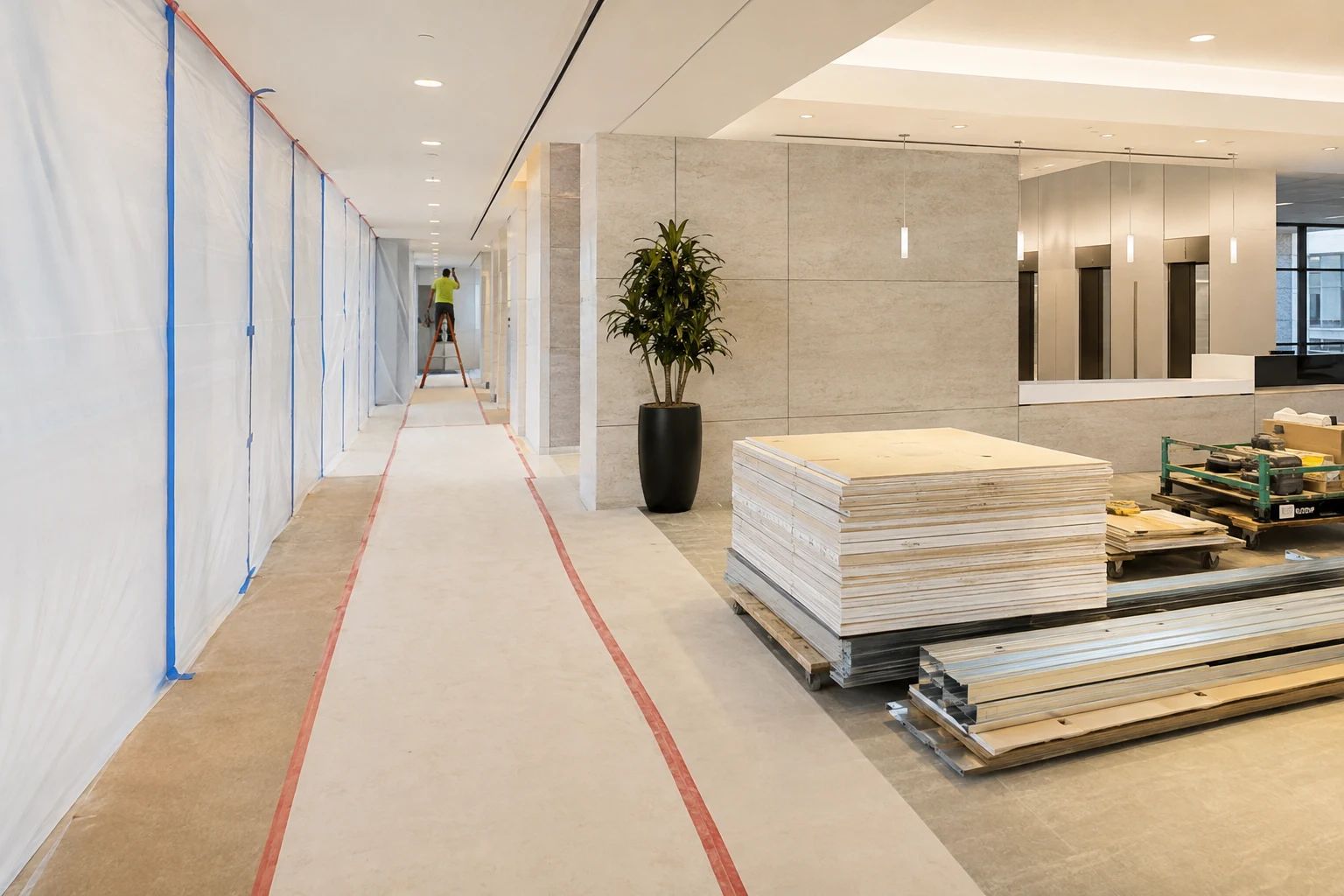
Commercial Renovation Planning Guide
How to organize due diligence, approvals, scope, phasing, procurement, and turnover for a commercial renovation or tenant improvement.
Read article
How to Compare Contractor Bids
A structured method for comparing scope, allowances, exclusions, schedule, qualifications, and risk instead of choosing by total price alone.
Read article